<p>
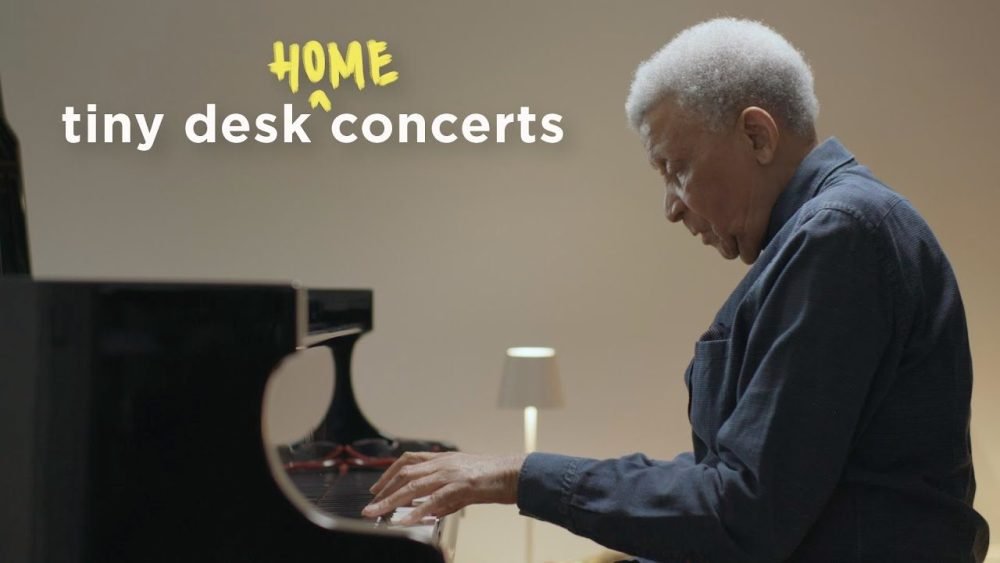
It is in a state of solitude that revered South African pianist
Abdullah Ibrahim performs his Tiny Desk concert. In his German
residence, he’s at center stage, surrounded by notes, vinyl, and
books. “It’s a pleasure to meet and a pleasure that we can share
a few moments together,” Ibrahim, looking masterly, tells the
camera.
<br>
</p>
<p>Playing three tracks: "Blue Bolero," "Signal On the Hill" and "Once
Upon A Midnight" from his enchanting and introspective 2021
album <em>Solotude</em> (Gearbox Records), Ibrahim interrupts the
silence to share some stories.
</p>
<figure><iframe loading="lazy" src="//www.youtube.com/embed/L5i4stj4M30" allowfullscreen="" width="500" height="281" frameborder="0"></iframe></figure>
<p>
In the liner notes of <em>Solotude</em>, he explains that at “six years
old, I played my first note on the piano with the index finger.
Now 80 years and 10 fingers later – a journey that took me from
Cape Town to all corners and mentors of the world – the index
finger unveiled plays itself – the one note of universal unity. My
great grandfather with his index finger showed me the hidden Kalahari
dreamtime essence of the plants, flowers, animals and sound of the
distant hills.”
<br></p>
<p>“For 13 short
minutes, I feel seated in Abdullah Ibrahim's home in Chiemgau,
Germany, witnessing seven decades of experience slowly dripping from
his fingers and touching my soul,” Bob Boilen, creator of NPR's
Tiny Desk, added. “In my 18 years directing <em>All Things Considered</em>,
I'd often reach for his music to play between news stories to give
the audience a chance to think and reflect.”
<br>
</p>
<p>Halfway through his
performance, Ibrahim addresses the camera again:
<br>
</p>
<blockquote>
<p>“Solitude. Through
the years, I’ve been blessed with being in the company of masters
and learning from them all over the world. When we go to school, the
first teacher tells us, ‘One plus one equals two.’ In the African
tradition, our first teacher is the master. And the master will tell
you, ‘This is two.’ So, that starts the life’s journey under
the guidance of the master to understand what two is. It’s a long
and arduous journey, and one that we accept."
<br>
</p>
<p>"One of my masters in
Japan, I’ve studied with him now for over 50 years…it’s a
principle in Japanese culture <em>called</em> <em>Ikigai</em>. Ikigai, which means,
‘When you wake up this morning, what is it that you really want to
do, not what somebody else wants to do?’ Ikigai. So, a few years
ago, the master gave me a diploma to teach. And I said, ‘Why do you
give me this diploma? I don’t know anything.’ He says, ‘That’s
why I gave it to you. Me too. I don’t know anything.’ So, we can
continue this process that we’ve been inspired by all these master
musicians and mentors.
<br>
</p>
<p>We practice 25 hours
a day. Solitude. Thank you.” </p></blockquote>
<p><br></p>
<p>Now, Ibrahim’s the
master. With one final note, he inhales and closes his eyes.</p>