Review August 8, 2005
Khaled, 2004: Part I
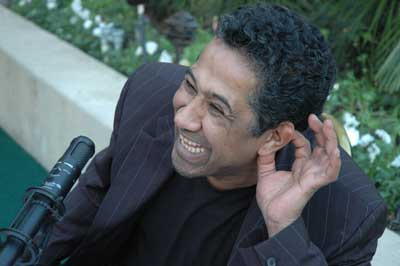
<p><em>In December, 2004, Khaled came to Los Angeles to put the final touches on the U.S. release of his album Ya Rayi. He sat down with Banning Eyre and Sean Barlow for a lengthy interview, over three hours of thoughts and recollections. As a mid-summer feature, hot on the heels of the Khaled and Friends tour, we now give you that interview in three parts. The first installment focuses on Khaled’s youth. He told Afropop that his whole artistic personality and conception of life was crystallized during his youth in the Algerian port city of Oran, the birthplace of rai music.</em></p>
<p><em><strong>Banning Eyre: Tell me about the Oran you grew up in.</strong></em></p>
<p><strong>Khaled:</strong> Oran is a city situated in the west of Algeria. It is surrounded by Spain, Morocco, and also the Southwest Sahara. Oran has always been a city open to music. It's a city that has many ethnic groups, many different kinds of people, because it is a port. I think that when a city is a port, there are more vibes there, more people coming, more cultural change. There was a lot of culture there. People came to Oran just to understand the city. It is a place where you don't feel time passing. I was there in 2004 to perform a concert for the 11th century of the city. Unfortunately I couldn’t sing very much. I sang one song, and the second song I couldn't. My voice wouldn't function. I didn't know why.</p>
<p>I was born in the Spanish quarter, la Caléra. There's another quarter called Les Planteurs, at higher elevation. It's in the mountains, near Santa Cruz, named for the Spanish virgin. There's another quarter called Eckmühl, the German quarter. That's where I grew up and spent my childhood. Then there was another quarter where my aunt lived, Cholet. The military had a lot of barracks there. We had a French quarter, Larbi Ben M’Hidi. When we were colonized, this was the center of town, the most European quarter. Then there was the Jewish quarter, Derb Yahood—Yahood: that means Jewish—and as you got to the port, the Spanish quarter, where I was born, in 1960.</p>
<p>Oran was a place of many different mentalities. You had a quarter where everything felt European, a quarter where everything felt American, the Jewish quarter, the Spanish quarter, and a quarter where you felt truly Oranaise. That's different. It's like in Brazil: you have the rich neighborhoods, and you have the shantytowns. Rai music came from the shantytowns, where there are the bars and taverns. This was more in the Spanish quarter, the poorer quarters, where people didn't live well. But this was the richest quarter musically, the place where all the music was played. This was the new city. The new city was slower. There were two big roads, and in the middle was the place they called Tataha, the new city. This was more like a quarter you would find in Marrakesh, like the square where you find all the snake charmers, jugglers, and all that.</p>
<p>At the time, this was where you found the <em>gasba</em> players, the real traditional <em>rai</em>, all the <em>cheikhs</em>—that is to say, the masters. That's the old word. <em>Cheikh</em> means master. Respect to the master. Whether he is an artist, a singer, or poet, one always respects him, because these people speak for the community. They report things. If you have no light, no television, these are the people who say, "Yes, tomorrow the king is coming." This quarter was full of raconteurs, people who could recite history. Also poets. There was so much music, music from Morocco, Jewish and Andalusian music.</p>
<p>For me, Oran is crazy-ville, a city of folly, a city of attractions. For example, there are the oranges. About 10 kilometers away, not far, when I was young I would go there on the weekends. The town is called Missereguine. It's the town of the Clementines, those small, sweet oranges. It's a big town, but filled with forests, and trees filled with Clementines. Before you enter this domain, you pass the church where Father Clement, the man who invented the Clementine, was buried. He was buried in Oran. When it was hot, we would head for Missereguine, take a picnic, and spend a fantastic day. There was a little cave, and everyone would bring a candle to light it up. And inside you would find fresh water from a spring. Anyone in Oran who had a car, if you were not too poor, you would go there to have barbecues, with the whole family, pass the day, the night, the whole weekend there. With the Clementines, and Father Clement.</p>
<p>When I was young, the first school I went to was a religious school, a French school, with the Fathers. Catholics. Yes, I grew up with that. That was happiness. I was young, and I would see the nuns, and I would say, "Hello, my sister." For us, this was something new. I was three or four years old. "Good day, my sister." "Good day, my son." This was super! I grew up with this happiness. Over there in Algeria.</p>
<p><strong>B.E.: Your father was a policeman, right? </strong></p>
<p><strong>Khaled</strong>: Later on, yes. But back then, he worked in the port in order to feed us. He was a docker. He worked at the Naval base, the military base. And then the port, with the fishermen. That was just next-door. My father worked at the Naval base when we were colonized. He worked with the French, as did all Algerians, in order to eat. He would see a boat coming in, and he would find something to do, to work, to eat. And also, when the military was in need of a hand, they would call these guys to work.</p>
<p>So I was born in 1960, and in 1965, I was with the priests. And after that I went to primary school. After independence in 1962, the French stayed on to teach. They taught us to read and write. Essential things. It was still in French, diplomatic school, in French. All the lectures were in French. A lot of Egyptians and Syrians came to teach us literary Arabic, classical Arabic. Because we in Algeria, in North Africa, have another language. We have our own dialect. In Algeria there are many mixings of language. The people in Algiers do not speak like the Oranais. The people in Oran, in the West, do not speak like people in the East. We have our own Arabic dialect. My Arabic, that I learned in Oran, has a lot of Spanish and French in it. Especially Spanish. For example, at home when we want to sit in front of a table, we say “<em>tabla</em>.” When we want a fork we say “<em>focheta</em>.” When we want a napkin, we say "<em>servita</em>.” The “v” always becomes a “b”. Instead of saying “<em>servir</em>” we say “<em>serbi</em>.” Like my song, “Serbi Serbi.”</p>
<p><strong>B.E.: Why is there Spanish there?</strong></p>
<p><strong>Khaled:</strong> Oran has always been like that. I grew up with flamenco. When I opened my eyes, I wanted to learn the guitar, because in the town where I grew up I heard nothing more than Spanish. My mother spoke Spanish. My father spoke Spanish. All the old people, all the big people of Oran, spoke Spanish. We're not far from Spain. It's a short journey, two hours by boat. Oran was full of Spanish people. We grew up with Spanish people and Moroccans. But in my town, it was especially Spanish. That's why the Jews among us created this melange of music, music called Arabo-Andalus. And it was from there also that we got the influences in <em>rai</em>. <em>Rai</em> was like country music. It came from the provinces. Before that, there was folkloric music, the <em>cheikhs</em> and <em>cheikhas</em>. Like Cheikha Remitti, with the <em>gasba</em>.</p>
<p><strong>B.E.: What about <em>wahrane</em>?</strong></p>
<p><strong>Khaled:</strong> [That was the name for the local folk music of Oran.] But there was also Blabas, Boutledis, Lamariya, right to the Moroccan border, right to Oujda, and <em>rai</em> music.</p>
<p><strong>B.E.: So when we talk about <em>wahrani</em>, that is Oran specifically.</strong></p>
<p><strong><br></strong><br></p>
<p><strong></strong><strong>Khaled</strong>: It's like Oran is Hollywood. <em>Rai</em> comes from Orange County. It's to the side, from the little provinces. It's a little bit here and there. But when they talk about the principal town, that's Oran. All the people from the small provinces came to Oran to earn a living, because Oran was the port. Peoples can circulate their. For artists to live they have to go to the central town. It's like if you are from Los Angeles, you go to Venice Beach and you find everything. Oran was the principal capital. All the artists came there to be recorded, to get known. Even poets. To become known, everyone came to Oran.</p>
<p><strong>B.E.: And this is how the music of the provinces, <em>rai</em> music, came to the city.</strong></p>
<p><strong>Khaled:</strong> Yes. It came to the city. Why did people come to Oran? It is a beautiful thing. As I was saying before, in Oran there were all the races. The American quarter, the Jewish quarter, and so on. People came because it was more interesting. If you were a <em>cheikh</em> or <em>cheikha</em> with your <em>gasba</em>, you came to Oran and heard flamenco. [SINGS]. "Ah, I can sing like that." So that created this marriage of influences. Everyone takes something from everyone else, and makes their little salsa, their sauce.</p>
<p><strong>B.E.: Do you remember any songs from back then like that? Can you sing one? </strong></p>
<p><strong>Khaled:</strong> Yes, of course. There are many things. One thing that made me laugh was that there was a waltz that came from Lotriche. We used that a lot in <em>rai</em>. The waltz was widely used in Oran but we made it different. [SINGS RHYTHM] It’s more dancing, more waltz. [SINGS MELODY FROM “Ensa El Hem.”] It's another thing. It's more melodious. It's like jazz and blues. <em>Rai</em> is like that. If you look at the history of blues and jazz, you find the history of <em>rai</em>. Jazz and blues is about people who are suffering, people who are hungry. They made blues because it was like their religion—telling stories, saying words of suffering, of life. And also, there were no notes to write down. You don't write it down. The music of the <em>cheikhas</em>, you can't write it. Their big instrument was the <em>gasba</em>. The Egyptians call it the <em>ney</em>. The <em>ney</em> is more fine. But the <em>gasba</em>—for a laugh, we used to call it the six-cylinder. Like a car engine. Why did we call it six-cylinder? Because often, when people drank a lot, and they heard the sound of the <em>gasba</em>, they were moved. They drank more. It got inside them. It made them sad. It made them artists. It's like when you hear the contrabass, or the sax. Okay! You drink your whisky. At that time, when people went to weddings, had evenings among friends, when the <em>gasba</em> played, there was no microphone. They heard only a <em>cheikh</em>, the poet. Because there was no melody. It was poetry, people telling stories. Love stories. It's like rock-and-roll talks about peace and love. That's cool. I want to play that. I like that. I want to be in love. I want to break the taboos. I want to be human, drinking. It's not bad. It's what I <em>feel</em>. Rai was that, people in love, people who want to hear a story, because they feel bad. When the poets wrote, they wrote their own stories, but they touched other people, because it's the same line for everyone. That's why I say <em>rai</em> sings the life of everyday.</p>
<p><strong>B.E.: And that everyday, universal appeal was in the music of the cheikhs, even before there was rai?</strong></p>
<p><strong>Khaled:</strong> Yes. Before, before. Excuse me, but I have to explain the six-cylinder. The <em>gasba</em> is made from bamboo. But it's not for small bamboo; it's the big one. Big bamboo and it's longer than the <em>ney</em>. The <em>ney</em> is short. Small. And the <em>ney</em>, in Egypt and the Middle East, is used in music played for someone who has died. It's sad. It's crying. It's meditating.</p>
<p><strong>B.E.: I have heard it said that the ney represents the sound of the human soul. </strong></p>
<p><strong>Khaled:</strong> Voilà. Yes. Spiritual. But the <em>gasba</em> is long. And it has six holes, three and three. The <em>ney</em> has eight, six, and then two behind. The <em>gasba</em> does not have the two behind. The <em>ney</em> has the quarter tones, and two holes behind. But the <em>gasba</em>, no. SINGS. People play the way they feel. SINGS. There are no notes. It's like flamenco. The <em>gasba</em> has no pitch. I have never found a <em>gasba</em> that has my pitch. So, fa, mi—no. No way. It's like the Gypsies, when you find a guitar, it has no pitch. [WILD IMITATION OF FLAMENCO GUITAR] That's it.</p>
<p>I think that Gypsy music is number one, before rai. It's been all over the world. It comes from where? From the Indians. It's incredible. It's not possible. Me I found out only later. When someone told me it was Hindu music, I said, “No way!” Hindu music arriving in North Africa, where we have flamenco? And after flamenco you go to Egypt, to Alexandria, the province we call Said. You find people who sing at marriages, in the Oriental style. They sing flamenco. That is to say flamenco came from India, to North Africa, to the Middle East. I think that is beautiful, and what I really want to say, is that music and people <em>traveled</em>. They had no passports. Sadly, we live in a world that is different. But at that time, and what I want to say, is that people lived in misery. There was a lot of misery. There were no airplanes. There was no way to get around. There was more suffering, sickness. But at the same time people played music. People lived with music. For me, music is to be alive. It tells you things. Now, music is also a motor for passing messages. But not to pass bad messages. The poets were there to cross boundaries, to reveal suffering.</p>
<p>Look, for example, at my home. We were colonized. I won't tell you something that is super beautiful. When one is colonized, one lives with someone else. The Arabs, the Muslims, lived with the French. It was French Algeria. We were colonized. But the poets, at that time, who wrote the <em>rai</em>, <em>wahrani</em>, Oranese music, the music of the <em>cheikhs</em>, they were not racists. This is beautiful. The words of <em>rai</em> were beautiful. People when they wrote a song, they didn't write it in their language. They wrote in their language, but they shared with the people who lived with them, even if the person wasn't from there. They were welcomed. Even if they were colonizers. Welcome, because we are together. We live together we eat together. We sleep in the same city. There is no problem. People wrote in Oranese dialect and in French. There was no problem.</p>
<p>There's one song I really like. This guy wrote a love song. He said, "I am sick. I have a fever. I think of love a lot. I cry my sorrow." [FRENCH AND ARABIC] It is universal. I live the moment. I see it. I feel it all the time, especially when I sing. When I sing, I'm in another world. I travel.</p>
<p><strong>B.E.:</strong> <strong>Tell us about some songs that take you back to Oran. </strong></p>
<p><strong>Khaled</strong>: Yes, yes. I will get there, slowly. That's why I am telling you the story. I am telling you my life. There was a song I repeated on my third album. It was called “Bahhta.” “Bahhta” is the name of a woman. When a man courted a woman, he had to look before he touched, two years, three years, five years. Until then, he's watching through the window. But this poet named Khaldi wrote 196 couplets for this woman, Bahhta. And the first word he began with was Madame. First word. In French. Because he was afraid of her. He was in love, but he was afraid of her. So he said, Madame. So today she has come. Because he had a fight with her. She left. She went home. She lived in Tiaret, very far away, on the plateau, 400 km from Oran. This guy came from Maskara, the home of Emir Abdel Kader, who died in Syria, and was repatriated in Algeria.</p>
<p>This was in the time of Napoleon. Emir Abdel Kader knew Napoleon. He was a great warrior himself. So Khaldi came from this town, Maskara. But he was chased from his town, and he came to Oran, where he became a poet. He is to frequent a particular bar. And at that time, there were no cars. For taxi, they had the <em>kalesh</em>, like in Spanish, <em>le coche</em>. <em>Kutche</em>. The horse driver. In Morocco, you say <em>kutche</em> for the car. But at the time, it was the horse. Anyway, the poet stayed six months without seeing anybody, and six months without seeing her. So he was sad, but he was also proud. Who is going to make the first move? Each one said, "Ah, no." But at a certain point, the woman couldn't take it anymore. She took the train from her home, and she came to Oran. It is beautiful when they meet again. This is where I took my couplets from. It's beautiful. It's powerful. He says, "Madame, today she has come. She is the most beautiful of beautiful. She has eyes like the sun. She is the most beautiful of all women. Bahhta, when I look at you, it is like watching the sunrise.” Bahhta is a petal of the flower in this elegy. I took my couplets from this place when he is nervous. He says, "She has come on the train.” And when she arrived on the train—at that time, there were only men in bars; women did not come—she took the <em>kalesh</em>, the <em>coche</em>.</p>
<p>At the station, all the taxi drivers knew where Khaldi was. They knew that Bahhta was the love of Khaldi. So one said, “Madame, don't worry. Come with me. I will take you to your love.” So Khaldi writes, “She came by the train, two hours by train. She sent me, the messenger." Because the messenger was the driver, sent to pass me a message of love. But he says, "But the messenger did not pass the message of love. It was the message I was in the process of thinking about with sadness." That is to say he at the same time was thinking about her. And he adds, "But when I saw her in the <em>kalesh</em>, she was like a general." Now he talks military. "She was like a general leading a section. Commanding her section. With a neck like an ostrich." Because its neck is so beautiful. And her face was made up. It was dolled up like an angel’s. He says, "But when I saw her, my heart was beating, and I had no more force. I was dead. I was afraid. I could do nothing.".</p>
<p>But it's beautiful. It's pretty. <em>Rai</em> spoke about nothing but love and life. And right up to now, it speaks about nothing but that. And in this mix, there is no problem of religion. Among the Jews of Andalusian, the Arabo-Andalus, you find those who sing Jacques Brel, Edith Piaf. They sing the French. You turn your head, you find another one singing in Spanish. Classic. You see the small, before musician playing blues and jazz. The <em>cheikhs</em> and <em>cheikhas</em>, with their little <em>djelaba</em> and the <em>gasba</em>. And women and men together. There are those who say you should not see the face of woman. But the face of the <em>cheikhas</em>, the women who sing, was not the face of the Talaban. No. No way. No, no, no. It was just a matter of respect. There is to veil with many small spangles attached to it. That makes it glitter like gold. But she can see well. And when you see her face, you look for her eyes, even with the gold that shines at you in the light.</p>
<p>And what was beautiful is that the women drank. When she stopped singing, she took her glass of wine. And what is pretty is that she pulled the curtain in front for in order to do that. I will say, "Draw the curtain." Afterwards, she comes out. LAUGHS WITH DELIGHT. This is conviviality. In this new life, you turn your head, and you found that in the Spanish quarter which my father also frequented. You also found the little shrimp, the fish, the sardines served on a plate or just on a napkin. And they drank. They drank <em>mahia</em>, what the French call "the water of life." It's Anisette, like Pastisse. The people of Oran, my people, they prepare that with 90% alcohol. They take the extract and they prepare that. You have to know how to prepare that. So they would pass the evening drinking <em>mahia</em>, and <em>anisette</em>. Anisette is always in <em>rai</em> songs also.</p>
<p><strong>B.E.: Can you sing a little of that song, so I will remember it?.</strong></p>
<p><strong>Khaled</strong>: SINGS. You could say it a waltz Oranaise. But with us, people do not dance. They are listening very intensely to the words. Why do they create this kind of waltz? You could say it is slow. It's more about listening to the words, and thinking about what they say. It's a more of a story. It's different from today. Today it has become something else. These days, its speakers and microphones. Back then, there were no microphones. There was just the <em>gasba</em> (flute) and the <em>gallal</em>, percussion. The <em>gallal</em> is a piece of water pipe. You would cut it and add a skin to one end, and play percussion. There was a poet, a singer, called Hemada. My father was a fan of his. There were others as well, but Hemada and these singers of folklore they always had a big signet ring. The <em>gallal</em> let him play muted, like this. [DEMONSTRATES VOCALLY] Then when he sang, he would tap his ring against the corner of the <em>gallal</em> to make a sound, like the click the computer gives you to keep time in the recording studio. So it was a muted, slow, and people listen to the story that the artist was telling.</p>
<p>During the second world war, there was a Jewish, Arabo-Andalus kind of music. There was a song. I don't even remember who sang it. It was a Jew from Algeria, from North Africa. There were the Americans who had come, the English, the whole world who had come to liberate France, passing through North Africa. And the Americans, when they came to Oran, this guy sang a song. Oh my God, I've forgotten the words. But what was beautiful was that the words in French were super great. [SINGS] He sang about the American, America. And he said that the people were happy there. Even though they couldn't understand English, they were the poor of North Africa, he would sing, "We are happy. When the Americans came, everyone who could not speak English learned three words. And in the street, you would just hear those words: OK, Come on, Bye-bye." LAUGHS These are the three words they learned to speak with the GIs. And the Americans learned “<em>bonbon</em>.” The <em>bonbon</em>, and the chewing gum. That was an American. OK, Come on, Bye-bye. That was conviviality. There was a bad man [Hitler], a fascist, someone who is doing bad things on the earth. So the world was responding, the Americans, English, everyone, especially the Senegalese, the poor blacks of Africa. There was a name for them. I have forgotten. The French sent them first against the Germans, so that people could live in peace, and freedom. Freedom! People were happy, Jews, Muslims, French, everyone.</p>
<p>The allies’ base was North Africa. Why North Africa? Because we were colonized by the French. And why North Africa? Because the Germans had gone around, via Tunisia and the Middle East, to go to Libya, Mauritania, and to come out the other side. And the Americans were on the sea. They came from both sides, and closed the buckle. That's for the warriors. I am not a warrior. But that's the story. And this is what I say, we don't hear about this very much. They don't show this. Because if they showed this, and if they had showed this, what happened back in the time, people wouldn't have become so crazy. If we showed how people suffered to bring freedom, how they died, to give us the life we have today. This is of why the earth exists. We can see it in this history, Christians, Muslims, Americans, Jews, Buddhists, everyone is there, hand-in-hand trying to be together happy in this world. That's what's fabulous.</p>
<p><strong>B.E.: When you were born in 1960, it was near the end of the Algerian war. But the memory of the Second World War, the presence of the Americans and all that, was still very recent, wasn’t it?</strong></p>
<p><strong>Khaled</strong>: Yes, but I was not involved in that. I grew up in peace. I saw this with my eyes. I didn't even know the sound of a pistol, a gun. Not even a sound. No. There was nothing. Nowhere. Even when the war was over, we lived with a dictator. What was beautiful was that we didn't sense that it was a dictator. We didn't know. My generation. For me, when I was young 15, 16, I started smoking. I started to understand cigarettes. At 18, I started drinking alcohol. For me, life had begun. We did not have the right to just go out drinking a bottle of alcohol, just like that. No. But everyone knew that people drank. Bars existed. No one stopped it. Nowhere. No, no, no. We lived well. That is to say, we lived hidden but happy. This is because we were minors. We were young. We couldn't go into bars and nightclubs. Not yet. We could go when we were 20. First we had to do our military service. There is to say, to loose your virginity, you had to do your military service. Then you could go where you liked. Because you had become an adult. Military service was what? It was used to control men.</p>
<p><strong>B.E.: But you did not want to do that, right?</strong></p>
<p><strong>Khaled</strong>: I did not do it. Until now. No. No. Thank God! [LAUGHS]</p>
<p><strong>B.E.: How did you avoid it? </strong></p>
<p><strong>Khaled</strong>: I suffered for that. I saved myself. Hidden and happy. I had two older brothers. One of my brothers was a champion athlete in Africa. The other was a good student, expert accountant, technician. Now he is a radio technician. I was the bad boy of the household. I was the hopeless one. No way. No. My parents, everyone gave me shit. I had some terrible moments. The foolishness. Lots of foolishness. But I was nice. For us a bad boy was someone who goes out and comes home at three or four o’clock in the morning, who doesn't listen to his parents, neither mother nor father. I was like that. I did what I liked. And then there was alcohol, cigarettes… “No, you are not yet old enough!” The way it was at that time, if you smoked a cigarette outside, anyone could slap you. Anyone. Even if it wasn't your father, even if it wasn't your brother. They could hit you. “I'm going to tell your parents. You smoke in front of me? Before an adult? You should respect adults.”</p>
<p>I grew up with that. I grew up with respect for people who are older than me, and furthermore, when someone did hit me, and I when cried to my father, "Oh, this guy hit me," what you think he did? He hit me too. And you go, "What?" Yes, he hits you, because you've been misbehaving. [LAUGHS] And he didn't hit you for nothing. No. Because the parents knew that if their child does something like that in front of someone else, they are misbehaving. They learned that way. People are not fools. So when somebody hit me outside, I didn't even tell my parents. Eventually, nobody hit me outside. They knew I was crazy.</p>
<p><strong>B.E.: You had that reputation.</strong></p>
<p><strong>Khaled</strong>: <em>Voila</em>. And everyone respected that. Because I was a singer. A rai singer. And furthermore, if you’ll excuse the word, I was a <em>voyou</em> (delinquent). Like being in a gang, but not that, not violent. <em>Voyou</em> is like someone come says to me, "Khaled, come and sing.” Or “Give me money.” Ah, no. I will fight. I will defend myself. And people would say, “Ah, this one. He's crazy. Don't talk to him.” But always, there is respect.</p>
<p><strong>B.E.: There’s a song like that, “Maryule.” </strong></p>
<p><strong>Khaled</strong>: <em>Maryule</em>. I was a <em>maryule</em>. <em>Maryule</em> is someone who is happy. I love this word. It’s good. A <em>maryule</em> is someone who relieves the world, someone who smiles, who drugs, who is a man, who loves life. He brings joy. He has only positive things, not negative. When you see a <em>maryule</em> at a nightclub, in front of the door, before he even enters, he's already like that. Then you just say, “Ah, he is a <em>maryule</em>.” It's someone who gives happiness. And for a girl, what do you say?</p>
<p><strong>B.E.: The feminine of maryule? </strong></p>
<p><strong>Khaled</strong>: <em>Maryula</em>! <em>Voila</em>. [LAUGHS] And then there's the word <em>moreno</em>. I am a Moreno. It's the color. Brown. It's a Spanish word. We don't speak Arabic. We speak dialect, the dialect of North Africa. We learned Arabic in school with Egyptians and Syrians, because the Koran is written in Arabic. It was to learn religion. It's like Christians, when you go to school, you learn Latin. Why? For the Bible. It's for religion, Jesus. We learned classic Arabic because of Muhamed the Prophet, and Islam.</p>
<p>And also, me, when I was growing up, I learned literary Arabic, classic Arabic. I learned the Koran. I was learning religion. But when one teaches religion to a young boy, to children, even to men in a mosque, it's to give them wisdom. It is to become wise in life. Because religion speaks only of beautiful things, of wisdom, of the message of life. Life is beautiful. You must do only good things. When someone hits you, you turn the other cheek. No problem. The life of my religion is giving money to the poor, helping those who are less fortunate, respecting old people, respecting women, respecting all of life. That's my religion. Respect. And when you take a child to church to encounter Jesus, to be baptized, what do you tell him that Jesus said?</p>
<p><strong>B.E.: You must give to the poor, love your brother... </strong></p>
<p><strong>Khaled</strong>: Yes. It's the same thing. The same message. But this is not the religion we see today. I think that to be human, one should be given a lot of freedom. Otherwise it's not good. Of course as I was say, there has to be a balance. The fair thing.</p>
<p>[Khaled stops for a cigarette break, acknowledging that they are not good for you.] I'm not talking about marijuana. Cigarettes. I think cigarettes are a bad thing. I have my own father who died. It was the stress, and after that colonialism. My father lived with colonialism. He never saw what happened with terrorism. It's even more terrible what is happening with terrorism.</p>
<p><strong>B.E.: What year did he die?</strong></p>
<p><strong>Khaled</strong>: 2001. But my father was a bon vivant. I have to find the photographs. My father, he had so many things, but when he died, I wasn’t there to help. I was afraid to go to the cemetery because there might be terrorism. But one month before he died, he came to Paris. I brought him to France. He was sick. He had cancer. The cervical cord was blocked. There was a moment when he could no longer move his hand. Cigarettes, stress, coffee. Coffee, cigarettes, coffee, cigarettes. And stress. Stress! And I’ll tell you something. All of Algeria is diabetic. I did a concert as a gift to the diabetics, because there was no insulin in 2000. The first concert that I performed in Algeria in 2000 was for them. My father died in 2001. He was alive when I came to do that concert.</p>
<p>Thank God, with [Algerian President] Bouteflika, it’s okay now. In the past, you couldn’t get insulin, because the terrorists burned everything. They wanted everything for themselves. I have a cousin in France, in Grenobles, a young guy. He didn’t grow up in Algeria. He was a policemen in France. At a certain moment, he came and said, “Khaled, I need to do something to earn some money. I want get a bunch of medicines and training them to Algeria. Do you know how I can do that?” I said I could make a call so there would be no trouble with customs. He took two trucks loaded with insulin, cotton and supplies. He wanted to make a gesture.</p>
<p><strong>Click here to read <a href="https://afropop.test.ejaedesign.com/multi/interview/ID/80/In%20Part%202%20of%20our%20LA%20interview,%20Algerias%20Khaled%20discusses%20his%20early%20career%20and%20the%20roots%20of%20rai." data-cke-saved-href="https://afropop.test.ejaedesign.com/multi/interview/ID/80/In%20Part%202%20of%20our%20LA%20interview,%20Algerias%20Khaled%20discusses%20his%20early%20career%20and%20the%20roots%20of%20rai.">Part 2</a> or <a href="https://afropop.test.ejaedesign.com/multi/interview/ID/83/In%20Part%203%20of%20our%20LA%20interview,%20Algerias%20Khaled%20talks%20about%20his%20new%20album,%20Ya%20Rayi." data-cke-saved-href="https://afropop.test.ejaedesign.com/multi/interview/ID/83/In%20Part%203%20of%20our%20LA%20interview,%20Algerias%20Khaled%20talks%20about%20his%20new%20album,%20Ya%20Rayi.">Part 3</a> of this interview.</strong></p>