Interview March 31, 2026
Cheikh Ibra Fam Contemplates “Life” with Aduna
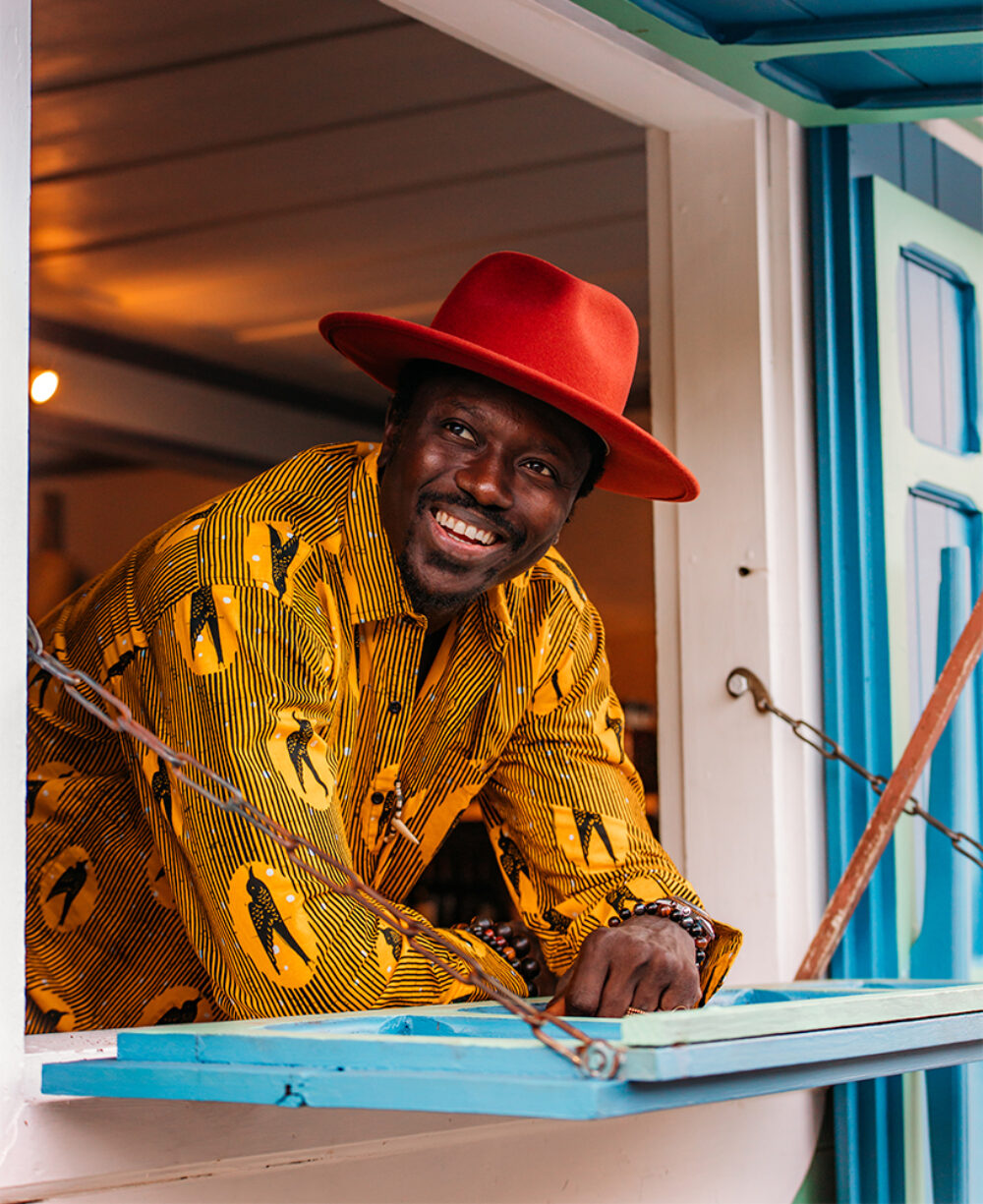
<p><em>Cheikh Ibra Fam is a Senegalese singer/songwriter/bandleader with a storied past. That includes immersion in the traditions of Baye Fall brotherhood, classical music training in Italy, a stint singing in the legendary Orchestra Baobab and a new life on Isle de la Réunion. In January, 2026, Afropop’s Banning Eyre had the pleasure of seeing Fam and his American band in a New York City showcase, and at the <a href="https://afropop.test.ejaedesign.com/articles/afropop-at-the-folk-alliance-international-in-new-orleans-2">Folk Alliance conference in New Orleans</a>, including at a party honoring the legacy of Dan Storper and Putumayo Records. </em></p>
<p><em>On April 10, Fam’s second international album, </em>Aduna<em>, will be released to the world on Cumbancha Records. It’s a beautiful selection of new songs reflecting the broad range of the artist’s unique path through life and music. In New Orleans, Banning sat down with Cheikh Ibra Fam to hear his story. Here’s their conversation.</em></p>
 <p><strong>Banning Eyre: Cheikh, it’s been great hearing you live these past days. So to start, tell me your story as a musician. How did you get into this crazy business? </strong></p>
<p><strong>Cheikh Ibra Fam:</strong> Yeah, crazy business. I like that. Well, I was born in Senegal, in Mbour, and I started doing music very young. The first time I sang was taking my shower. In Senegal, people don't like you to sing when you take shower. My mama would always tell me, “Don't sing in the bathroom, because you will never be lucky or become a great singer.”</p>
<p><strong>Really?</strong></p>
<p>Yeah, really. So I start singing in the bathroom, and one day, when I was about seven, eight, ten, I tell to my daddy, “I wanna become a musician.” He didn't want me to focus on music. He wanted me to go to school, because in Senegal, mostly in Africa, people think when you do music, you use drugs, you use alcohol, and it's not the right way to become a great person. And I say, “Daddy, I can promise you, I will never use drugs, I will never use alcohol, all those things, but focus on art.” And where I came from, we are Baye Falls; we are Mourides. It’s a Muslim community that is very understanding, very tolerant. They follow the religion, but they have their own culture, and when they meet, they always sing. </p>
<p>So my daddy said to me, “If you wanna become a musician, don't ever forget where you come from. Your name is Cheikh Ibra Fam, coming from <a href="https://en.wikipedia.org/wiki/Ibrahima_Fall" rel="noopener" target="_blank">Cheikh Ibra Fall</a>, one of the biggest Baye Falls, who always lead Mouridism to become a great and humble human person.”</p>
<p><strong>So you were named after Cheikh Ibra Fall, the great founder of the Baye Fall? </strong></p>
<p>Yes. </p>
<p><strong>There are many songs dedicated to him. </strong></p>
<p>Yes. Many songs. So to become musician, I can never forget where I came from. And that's why I always try to reflect that Baye Fallism. The way I first worked on my voice was to learn the melodies how to the <em>khassida</em> [religious chant, which he demonstrates beautifully]. </p>
<p>I started singing this type of of melody which is called Courel. Courel is close to choral, which is close to Gospel too, in English. So this is the way I learned how to sing, and my daddy asked me to stay in that spirituality. </p>
<p>My mama supported me in a different way to become a musician. For my first single, I went to the studio with my mama. We hid from my dad that I'm going to record music. My first single came in 2006, and when we released that song, one day I had to tell to my dad, “This is me.” He was driving the car with me and all my brothers, and we heard the song. My daddy listened and said, “Wow, this song is great. Who's singing?” I was afraid, and I said, “Do you think it's me?” He said, “No, it's not you. You cannot do this. But you should try to do something like this, because this is great.” And I said, “Dad, this is me.” He said, “Are you sure? From today, I will support you in music.” So then I went to Italy to the Academy of Music to learn how to play violin and piano. And then my dad brought me back to Senegal. So my career started in this way.</p>
<p><strong>Now what was it about that song that that moved him? </strong></p>
<p>It was a love song, but I think what made him change is not the lyrics of the song, but the melody. You know, maybe he thought this voice was like Cheikh Ibra, his son’s voice, and he wanted to know if this was me, so he can give me a lot of love and support. This was very important in my career to go to Italy to learn how to sing, how to do solfege, how to read music, which is very hard to learn in Africa. A lot of people don't read music.</p>
<p>So after I release my first album in 2007, I started going by the name Freestyle. When I started doing music, people in Senegal called me Freestyle in Senegal because in that moment, I was thinking, “Yo, I want to look like an American.” You know, in Africa a lot of musicians when they start doing music, they think they should try to be like Americans, sing in English and dress like an R&B singer in the U.S.. At that moment I was dreaming, but it's not the reality. Then after so many years, when I joined Orchestra Baobab and started touring with them around the world, and I saw the reality. The reality is as an African musician, you should represent only Africa.</p>
<p><strong>Banning Eyre: Cheikh, it’s been great hearing you live these past days. So to start, tell me your story as a musician. How did you get into this crazy business? </strong></p>
<p><strong>Cheikh Ibra Fam:</strong> Yeah, crazy business. I like that. Well, I was born in Senegal, in Mbour, and I started doing music very young. The first time I sang was taking my shower. In Senegal, people don't like you to sing when you take shower. My mama would always tell me, “Don't sing in the bathroom, because you will never be lucky or become a great singer.”</p>
<p><strong>Really?</strong></p>
<p>Yeah, really. So I start singing in the bathroom, and one day, when I was about seven, eight, ten, I tell to my daddy, “I wanna become a musician.” He didn't want me to focus on music. He wanted me to go to school, because in Senegal, mostly in Africa, people think when you do music, you use drugs, you use alcohol, and it's not the right way to become a great person. And I say, “Daddy, I can promise you, I will never use drugs, I will never use alcohol, all those things, but focus on art.” And where I came from, we are Baye Falls; we are Mourides. It’s a Muslim community that is very understanding, very tolerant. They follow the religion, but they have their own culture, and when they meet, they always sing. </p>
<p>So my daddy said to me, “If you wanna become a musician, don't ever forget where you come from. Your name is Cheikh Ibra Fam, coming from <a href="https://en.wikipedia.org/wiki/Ibrahima_Fall" rel="noopener" target="_blank">Cheikh Ibra Fall</a>, one of the biggest Baye Falls, who always lead Mouridism to become a great and humble human person.”</p>
<p><strong>So you were named after Cheikh Ibra Fall, the great founder of the Baye Fall? </strong></p>
<p>Yes. </p>
<p><strong>There are many songs dedicated to him. </strong></p>
<p>Yes. Many songs. So to become musician, I can never forget where I came from. And that's why I always try to reflect that Baye Fallism. The way I first worked on my voice was to learn the melodies how to the <em>khassida</em> [religious chant, which he demonstrates beautifully]. </p>
<p>I started singing this type of of melody which is called Courel. Courel is close to choral, which is close to Gospel too, in English. So this is the way I learned how to sing, and my daddy asked me to stay in that spirituality. </p>
<p>My mama supported me in a different way to become a musician. For my first single, I went to the studio with my mama. We hid from my dad that I'm going to record music. My first single came in 2006, and when we released that song, one day I had to tell to my dad, “This is me.” He was driving the car with me and all my brothers, and we heard the song. My daddy listened and said, “Wow, this song is great. Who's singing?” I was afraid, and I said, “Do you think it's me?” He said, “No, it's not you. You cannot do this. But you should try to do something like this, because this is great.” And I said, “Dad, this is me.” He said, “Are you sure? From today, I will support you in music.” So then I went to Italy to the Academy of Music to learn how to play violin and piano. And then my dad brought me back to Senegal. So my career started in this way.</p>
<p><strong>Now what was it about that song that that moved him? </strong></p>
<p>It was a love song, but I think what made him change is not the lyrics of the song, but the melody. You know, maybe he thought this voice was like Cheikh Ibra, his son’s voice, and he wanted to know if this was me, so he can give me a lot of love and support. This was very important in my career to go to Italy to learn how to sing, how to do solfege, how to read music, which is very hard to learn in Africa. A lot of people don't read music.</p>
<p>So after I release my first album in 2007, I started going by the name Freestyle. When I started doing music, people in Senegal called me Freestyle in Senegal because in that moment, I was thinking, “Yo, I want to look like an American.” You know, in Africa a lot of musicians when they start doing music, they think they should try to be like Americans, sing in English and dress like an R&B singer in the U.S.. At that moment I was dreaming, but it's not the reality. Then after so many years, when I joined Orchestra Baobab and started touring with them around the world, and I saw the reality. The reality is as an African musician, you should represent only Africa.</p>
 <p><strong>How did you end up joining Orchestra Baobab?</strong></p>
<p>At some point, around 2015, one of the great singers of Orchestra Baobab, Rudy Gomis, was very sick. And Thierno Koite [saxophonist], who is like my father in music, called me and said, “Cheikh, I want you to listen to Baobab songs.” I said, “I already listen to Baobab songs, because my mom loves music and in my house, we're always listening. Johnny Pacheco, Orchestra Aragon, soul music, Aretha Franklin, you know.” And he said, “No. I want you to focus on Orchestra Baobab, especially Rudy Gomis.” So then I spent like two or three weeks listening to Baobab every day. Thierno sent me all the songs that Rudy Gomis used to sing, and he he told me Rudy is very sick. He cannot travel with the band. And I listened, and I listened, and I listened, and I listened. </p>
<p>After two, three weeks, I think I am ready. One day, Baobab was rehearsing, they called me. I came, and I found Bala Sidibé [vocals/timbales]—rest in peace—Issa Cissoko [tenor sax], and I meet Yahya Fall [rhythm guitar], Mountaga Koite [congas], and Assane Mboup [vocal]. And they say, “OK, sing.” And I start singing. Before finishing the first song, Bala Sidibé say, “OK, it's OK, it's OK. Stop. We've got to go on tour. Go pack your things.” I say, “What happened?” The next week, we were in Oslo, Helsinki, Jerusalem, Glastonbury, WOMAD Festival, everywhere. </p>
<p><strong>Wow. Total immersion.</strong></p>
<p>But I was very stressed. And when we got to the U.K. to do a concert, <a href="https://afropop.test.ejaedesign.com/articles/nick-gold-on-ali-farka-toures-posthumous-release-voyageur">Nick Gold</a> [founder/director of World Circuit Records, the label that had released all the modern Orchestra Baobab albums] was coming, and when I knew that Nick Gold was going to come to see me sing, that really got me. I was very, very stressed. And I said, “Okay, let me try.” And I start singing. </p>
<p>After the concert, I was asking Nick Gold, in front of the band, “What do you think?” Nick Gold said, “Wonderful, amazing.” <br></p>
<p><strong>How did you end up joining Orchestra Baobab?</strong></p>
<p>At some point, around 2015, one of the great singers of Orchestra Baobab, Rudy Gomis, was very sick. And Thierno Koite [saxophonist], who is like my father in music, called me and said, “Cheikh, I want you to listen to Baobab songs.” I said, “I already listen to Baobab songs, because my mom loves music and in my house, we're always listening. Johnny Pacheco, Orchestra Aragon, soul music, Aretha Franklin, you know.” And he said, “No. I want you to focus on Orchestra Baobab, especially Rudy Gomis.” So then I spent like two or three weeks listening to Baobab every day. Thierno sent me all the songs that Rudy Gomis used to sing, and he he told me Rudy is very sick. He cannot travel with the band. And I listened, and I listened, and I listened, and I listened. </p>
<p>After two, three weeks, I think I am ready. One day, Baobab was rehearsing, they called me. I came, and I found Bala Sidibé [vocals/timbales]—rest in peace—Issa Cissoko [tenor sax], and I meet Yahya Fall [rhythm guitar], Mountaga Koite [congas], and Assane Mboup [vocal]. And they say, “OK, sing.” And I start singing. Before finishing the first song, Bala Sidibé say, “OK, it's OK, it's OK. Stop. We've got to go on tour. Go pack your things.” I say, “What happened?” The next week, we were in Oslo, Helsinki, Jerusalem, Glastonbury, WOMAD Festival, everywhere. </p>
<p><strong>Wow. Total immersion.</strong></p>
<p>But I was very stressed. And when we got to the U.K. to do a concert, <a href="https://afropop.test.ejaedesign.com/articles/nick-gold-on-ali-farka-toures-posthumous-release-voyageur">Nick Gold</a> [founder/director of World Circuit Records, the label that had released all the modern Orchestra Baobab albums] was coming, and when I knew that Nick Gold was going to come to see me sing, that really got me. I was very, very stressed. And I said, “Okay, let me try.” And I start singing. </p>
<p>After the concert, I was asking Nick Gold, in front of the band, “What do you think?” Nick Gold said, “Wonderful, amazing.” <br></p>
 <p><strong>That felt good, right?</strong><br></p>
<p>But at the same time, even that sign, even that okay, was not enough for me. I still had to learn a lot, because I think as a musician, we need to be humble and say that every day we have something to learn. I learned a lot from Orchestra Baobab, everything to make it perfect, not only the way I sing, but even on stage, the way I dress. I used to learn many things from Bala Sidibé. Sometimes when the music happened, I was touching the stand of the microphone. He say, “Don't touch!” And when I forget and I touch again, he takes a timbale drumstick and hits me on my leg. </p>
<p>Ah! The horrible, horrible things—"Rest in peace, Bala, I love you”--but the horrible things that he did to me in front of the crowd, in the middle of the festival. When everybody is singing, and bam! When I sing and I make a mistake, bam! I was shy, and one day I say, “Oh, Bala don't love me.” But he was doing it to teach me. Because if you do it one time, the second time it will never happen, because I knew that, “No, I don't want to leave this situation.”</p>
<p>So he taught me in a different way, and one day he called me and said, “Cheikh, sometimes maybe you think that I don't appreciate you. It's not the case. I see the potential that you have, and if I let you alone, you will never reach the potential that you have. You will give less. I see the talent that you have; that's why I'm very severe with you.” </p>
<p><strong>So was he right? </strong></p>
<p>He was right. I think so. Because before he passed away, when I released my album, <em>Peace in Africa</em>, in 2022 with Soulbeats, a label based in France, I invited Bala Sidibé to be on the album. He was there before me, early in the morning. He say, “This song is my song. This album is my album. That's why I'm here before you.” He took notes, he wrote the lyrics with me, he said, “I'm going to sing this with you on your album.” I said, “Thank you,” and the song was great, because he was thinking, writing about the future. “The Future” is the name of the song, and he was telling me what's going to happen. “You are the future.” He said in Manding, “God gave me everything. I’m happy, but it’s time for the future, and you are the future.”</p>
<figure><iframe loading="lazy" width="500" height="281" src="//www.youtube.com/embed/25Kn0e6zdlI" frameborder="0" allowfullscreen=""></iframe></figure>
<p><br>Three days after we released the song, Bala passed away, a man who sang all his life, more than 50 years singing and touring as a leader of Orchestra Baobab. He did his last song with me. Bala passed away during COVID. So I cannot say it's a gift, because I would have liked him to stay alive, but it was an honor for me to do that song with him.</p>
<p>When we recorded a video, he was not there, but we called one of the first great painters in Senegal, who's very old right now. He said, “I'm going to come to paint Bala.” So during the video, you're going to see at the end of the video clip, Bala’s face. </p>
<p><strong>So at that point, you were starting to release albums on your own. And now you have a new one on Cumbacha Records. Tell me about that. </strong></p>
<p>The new album is called <em>Aduna</em>, which means “life.” Sometimes people say,<em> la vie a belle</em>, life is beautiful. But I think it's not only a saying that people like to hear, but it's something that people need to realize. People need to realize that negativity doesn't exist. Everything is positive. Negativity is something that exists for people who are afraid. Negativity can exist for people who don't have faith. Everything is positive, because everything negative is a way to see clearly. We say in French, “Every deception is a light that shows the way forward. We always learn from our mistakes.”</p>
<p>So Aduna is something that we need to enjoy. So inside every song, you see only positive in life. For example, “Amoul Solo.” “Amoul Solo” means that people focus on material things, on luxury, on things that look expensive, but happiness is not so far away. It's just the faith in your heart. In Africa, you see, we don't have a lot in terms of money, but still we have a lot. Joy and happiness don't have a price. </p>
<figure><iframe loading="lazy" width="500" height="281" src="//www.youtube.com/embed/mGFySvjcYew" frameborder="0" allowfullscreen=""></iframe></figure>
<p><br></p>
<p>That's why this album is very important for me. It's the experience that I have since I started with Freestyle, thinking that I'm American. One day I did one interview on Senegal Youssou N’Dour TV, the animator said, “Today we have Freestyle, the most American Senegalese.” I was so happy in that moment, my friend. But now if you tell me I’m the most American Senegalese, I would say, “Don't tell me this, I'm just Senegalese.” So I’ve grown a lot in terms of vision of life.</p>
<p><strong>I see that. And I would never say you seem particularly American. I mean, look at you!</strong></p>
<p>So this is what I want to to say to my community, to the new generation. Let’s just be African. Let’s represent Africa not only with black skin but let’s represent the culture of Africa. If you go to Senegal you can discover a lot of melodies, a lot of rhythms, not only in <em>mbalax</em>, but music from the Serer community, the Toucouleur community, the Jola from Casamance. If you go to Kédougou, you find the Bassari. We have so many rhythms that sometimes it's sad because we didn't explore all the rhythms we have.</p>
<p>Even the Baye Fall the way they play percussion is so different. We need to to open our brains to know that if you go to the U.S., you cannot sell them the music that they already have. Let's be proud even with our language to sing in Wolof. When I was singing preparing this album, I talked to Jacob Edgar. Jacob is the person that I really need in my career, because the way he critiques you, he's so positive, but afterwards, you sit you say, “Hey, this man is right.” Because I used to sing in English sometimes, but Jacob said, “No. Don't sing in English.”</p>
<p>I said, “Why don't sing in English? English is fun. I'm young.” But he was right. If you sing in Wolof, you promote your country and your people. When I start singing only in Wolof, people loved it more that when I sing in English. When you sing in English, maybe they can they can say, “Oh, what he's saying? Let me hear well,” because you're not English. But when you sing in Wolof, even if they don't know what you are saying, they get goosebumps.</p>
<p><strong>That's interesting that Jacob told you that. I think a lot of musicians make this mistake. If their English is not great, it can take the feeling out of the music. It can sound less authentic than if you sing in the language you are most comfortable with. </strong></p>
<p>Even on stage, try to bring Africa on stage, but don't exaggerate. You don't need to bring a sheep on stage, or some curry. Because in this music industry—sorry to tell you this—there are some promoters who want cliché. “I bring this artist from the village in Mali! And from the village, he took the boat, and he's on this stage. Boom. Africa is here!” No. This is not Africa, because that situation changed the artist from Africa to become fake. “Let me try to be the most African, gris-gris, kora…” So at that moment, we are not natural and authentic. Authenticity can be modern, too. </p>
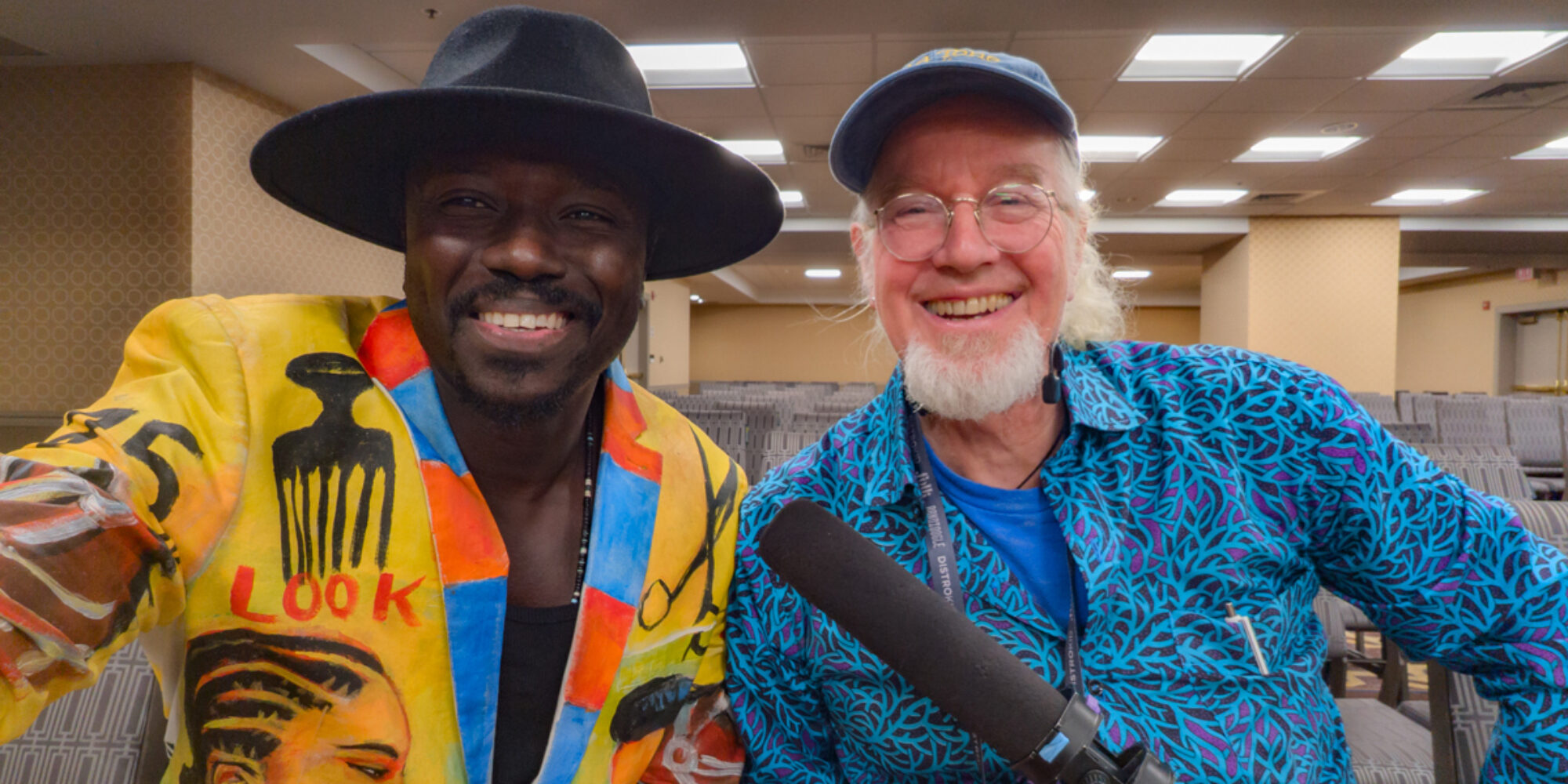
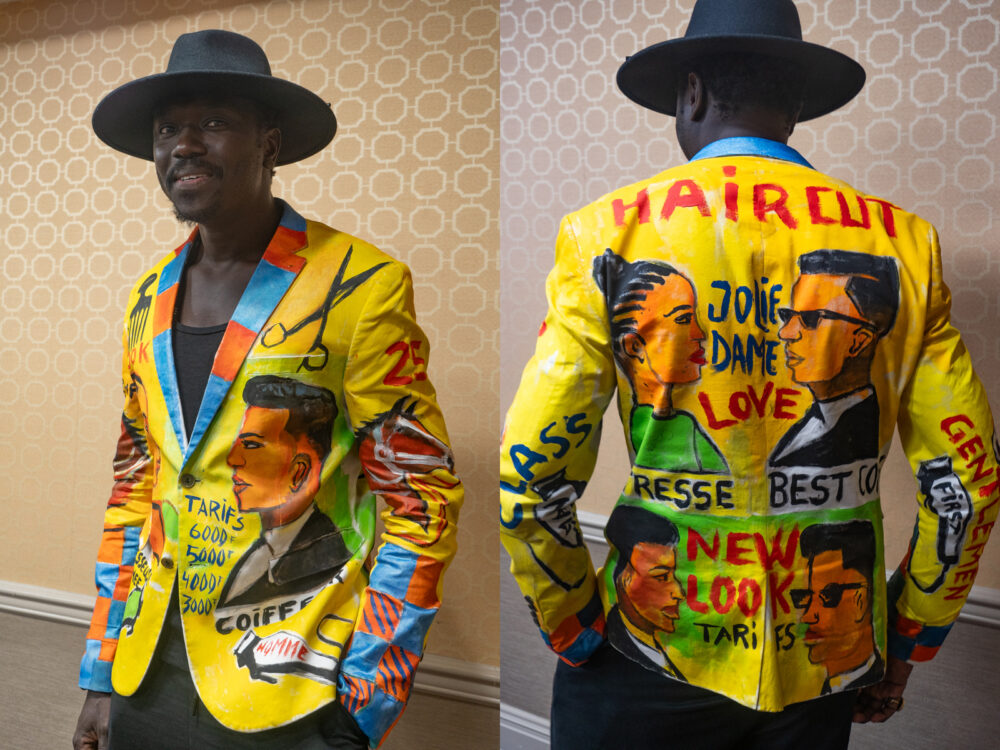
<p><strong>On that point, I have to say, I love this jacket you're wearing. This is a painted jacket. It is modern, urban, African style and it's beautiful. </strong></p>
<p>It’s from a friend of mine who's in Paris. His name is <a href="https://www.instagram.com/fallmokodu" rel="noopener" target="_blank">Mokodu Fall</a>. He is great, so thank you for highlighting him in this interview. So we don't need to exaggerate, we just need to be honest on stage. Africa is here, but African people are free to put on a suit, they are free to do whatever they want, but they still need to be authentic. <br></p>
<p><strong>That felt good, right?</strong><br></p>
<p>But at the same time, even that sign, even that okay, was not enough for me. I still had to learn a lot, because I think as a musician, we need to be humble and say that every day we have something to learn. I learned a lot from Orchestra Baobab, everything to make it perfect, not only the way I sing, but even on stage, the way I dress. I used to learn many things from Bala Sidibé. Sometimes when the music happened, I was touching the stand of the microphone. He say, “Don't touch!” And when I forget and I touch again, he takes a timbale drumstick and hits me on my leg. </p>
<p>Ah! The horrible, horrible things—"Rest in peace, Bala, I love you”--but the horrible things that he did to me in front of the crowd, in the middle of the festival. When everybody is singing, and bam! When I sing and I make a mistake, bam! I was shy, and one day I say, “Oh, Bala don't love me.” But he was doing it to teach me. Because if you do it one time, the second time it will never happen, because I knew that, “No, I don't want to leave this situation.”</p>
<p>So he taught me in a different way, and one day he called me and said, “Cheikh, sometimes maybe you think that I don't appreciate you. It's not the case. I see the potential that you have, and if I let you alone, you will never reach the potential that you have. You will give less. I see the talent that you have; that's why I'm very severe with you.” </p>
<p><strong>So was he right? </strong></p>
<p>He was right. I think so. Because before he passed away, when I released my album, <em>Peace in Africa</em>, in 2022 with Soulbeats, a label based in France, I invited Bala Sidibé to be on the album. He was there before me, early in the morning. He say, “This song is my song. This album is my album. That's why I'm here before you.” He took notes, he wrote the lyrics with me, he said, “I'm going to sing this with you on your album.” I said, “Thank you,” and the song was great, because he was thinking, writing about the future. “The Future” is the name of the song, and he was telling me what's going to happen. “You are the future.” He said in Manding, “God gave me everything. I’m happy, but it’s time for the future, and you are the future.”</p>
<figure><iframe loading="lazy" width="500" height="281" src="//www.youtube.com/embed/25Kn0e6zdlI" frameborder="0" allowfullscreen=""></iframe></figure>
<p><br>Three days after we released the song, Bala passed away, a man who sang all his life, more than 50 years singing and touring as a leader of Orchestra Baobab. He did his last song with me. Bala passed away during COVID. So I cannot say it's a gift, because I would have liked him to stay alive, but it was an honor for me to do that song with him.</p>
<p>When we recorded a video, he was not there, but we called one of the first great painters in Senegal, who's very old right now. He said, “I'm going to come to paint Bala.” So during the video, you're going to see at the end of the video clip, Bala’s face. </p>
<p><strong>So at that point, you were starting to release albums on your own. And now you have a new one on Cumbacha Records. Tell me about that. </strong></p>
<p>The new album is called <em>Aduna</em>, which means “life.” Sometimes people say,<em> la vie a belle</em>, life is beautiful. But I think it's not only a saying that people like to hear, but it's something that people need to realize. People need to realize that negativity doesn't exist. Everything is positive. Negativity is something that exists for people who are afraid. Negativity can exist for people who don't have faith. Everything is positive, because everything negative is a way to see clearly. We say in French, “Every deception is a light that shows the way forward. We always learn from our mistakes.”</p>
<p>So Aduna is something that we need to enjoy. So inside every song, you see only positive in life. For example, “Amoul Solo.” “Amoul Solo” means that people focus on material things, on luxury, on things that look expensive, but happiness is not so far away. It's just the faith in your heart. In Africa, you see, we don't have a lot in terms of money, but still we have a lot. Joy and happiness don't have a price. </p>
<figure><iframe loading="lazy" width="500" height="281" src="//www.youtube.com/embed/mGFySvjcYew" frameborder="0" allowfullscreen=""></iframe></figure>
<p><br></p>
<p>That's why this album is very important for me. It's the experience that I have since I started with Freestyle, thinking that I'm American. One day I did one interview on Senegal Youssou N’Dour TV, the animator said, “Today we have Freestyle, the most American Senegalese.” I was so happy in that moment, my friend. But now if you tell me I’m the most American Senegalese, I would say, “Don't tell me this, I'm just Senegalese.” So I’ve grown a lot in terms of vision of life.</p>
<p><strong>I see that. And I would never say you seem particularly American. I mean, look at you!</strong></p>
<p>So this is what I want to to say to my community, to the new generation. Let’s just be African. Let’s represent Africa not only with black skin but let’s represent the culture of Africa. If you go to Senegal you can discover a lot of melodies, a lot of rhythms, not only in <em>mbalax</em>, but music from the Serer community, the Toucouleur community, the Jola from Casamance. If you go to Kédougou, you find the Bassari. We have so many rhythms that sometimes it's sad because we didn't explore all the rhythms we have.</p>
<p>Even the Baye Fall the way they play percussion is so different. We need to to open our brains to know that if you go to the U.S., you cannot sell them the music that they already have. Let's be proud even with our language to sing in Wolof. When I was singing preparing this album, I talked to Jacob Edgar. Jacob is the person that I really need in my career, because the way he critiques you, he's so positive, but afterwards, you sit you say, “Hey, this man is right.” Because I used to sing in English sometimes, but Jacob said, “No. Don't sing in English.”</p>
<p>I said, “Why don't sing in English? English is fun. I'm young.” But he was right. If you sing in Wolof, you promote your country and your people. When I start singing only in Wolof, people loved it more that when I sing in English. When you sing in English, maybe they can they can say, “Oh, what he's saying? Let me hear well,” because you're not English. But when you sing in Wolof, even if they don't know what you are saying, they get goosebumps.</p>
<p><strong>That's interesting that Jacob told you that. I think a lot of musicians make this mistake. If their English is not great, it can take the feeling out of the music. It can sound less authentic than if you sing in the language you are most comfortable with. </strong></p>
<p>Even on stage, try to bring Africa on stage, but don't exaggerate. You don't need to bring a sheep on stage, or some curry. Because in this music industry—sorry to tell you this—there are some promoters who want cliché. “I bring this artist from the village in Mali! And from the village, he took the boat, and he's on this stage. Boom. Africa is here!” No. This is not Africa, because that situation changed the artist from Africa to become fake. “Let me try to be the most African, gris-gris, kora…” So at that moment, we are not natural and authentic. Authenticity can be modern, too. </p>
<p><strong>On that point, I have to say, I love this jacket you're wearing. This is a painted jacket. It is modern, urban, African style and it's beautiful. </strong></p>
<p>It’s from a friend of mine who's in Paris. His name is <a href="https://www.instagram.com/fallmokodu" rel="noopener" target="_blank">Mokodu Fall</a>. He is great, so thank you for highlighting him in this interview. So we don't need to exaggerate, we just need to be honest on stage. Africa is here, but African people are free to put on a suit, they are free to do whatever they want, but they still need to be authentic. <br></p>
 <p><strong>Where did you record the new album?</strong></p>
<p>The album was recorded in Réunion Island where I live.</p>
<p><strong>Wow. You live in Réunion? How come? </strong></p>
<p>I’ve lived in Réunion Island for five years. I'm a man who used to live in different cities. I lived in Italy, I live in Réunion, sometimes I can be in Monaco. I like to change because I like to go far. That’s my vision of life because even my song from this album, “Xam Xam,” I say, “To have knowledge, you need to wake up in Senegal and walk from Senegal to China, just for knowledge. Go far. The more you go far, the more you can have knowledge.”</p><figure><iframe loading="lazy" width="500" height="281" src="//www.youtube.com/embed/MiSoCb63jfU" frameborder="0" allowfullscreen=""></iframe></figure><br><p><strong>Good message. Réunion is beautiful. I went there once. It’s an incredible landscape with those huge volcanic mountains. Great music too.</strong><br></p>
<p>The experience that I have there in Reunion… I learned a lot of the story about slavery and music called <em>maloya</em>. If you see me today on stage, I have the <em>kayamba</em>.</p>
<p><strong>Yes, the rectangular reed shaker.</strong></p>
<p>When I arrived in Réunion, I developed a project about slavery, the Niama Project. Niama was a Senegal queen, captured in the moment of slavery from Senegal at nine years old, and she gets freed by her husband. She was freed because of love. She was captured in Senegal and arrived in the end of the year on Réunion Island. Then a white French man bought her, and freed her, and they got married. She got freedom by love. </p>
<p>And subsequently, they gave birth to one of the first French academic geniuses to emerge from slavery: Jean-Baptiste Lislet Geoffroy (1755-1836). He was a French academician, and his mother was Niama. He was of mixed race. His mother was a Senegalese slave. </p>
<p><strong>Fascinating.</strong></p>
<p>I've developed a lot of projects that I've had a lot of fun with. It's a pleasure to work with Afropop. Africa is a big place, but it doesn't have many seats in the room. In the room, we see so many chairs, often, Africa has two chairs, or even one chair, but you give a lot of space to Africa at Afropop. This is amazing, we need more Afropop, we need more Putumayo.</p>
<p><strong>Let me ask you about your band. When I saw you recently in New York, and here, you had a guitarist from Nigeria, an amazing drummer from Jamaica. The bass player was from Cameroon. </strong></p>
<p>You know, I was complaining a lot. “Oh, my gosh, when I go to Paris, I have a band. When I go to Canada, I need to make it happen, to have a band in Canada. When I go to U.S.,--because it's not easy. The visa fees. The situation... So you need to find a different way to be on the road. Then I saw the guitarist Carlos Santana, and he was telling his story that he used to have so many bands. He changed many bands before he was established, so I don't need to say anything anymore. </p>
<p><strong>So all these musicians are based here.</strong></p>
<p>They are in Washington, DC. That's my band when I'm here. Dokun, the guitar player, he used to play with Femi Kuti. He toured with Femi Kuti in Africa, in Europe, even in the U.S.. I like to give a lot of space to women. That's why I chose Angel as the drummer. She's great, and they all have knowledge of jazz. Most Africans don't read music. So with jazz, you learn how to read music, and you know how to play all different ways. If you see Femi Kuti, you will understand that jazz is important for African musicians. Even Yolo, he's from Cameroon, but he has that knowledge of jazz music. So I’m very happy to have this band. </p>
<p><strong>Well, thanks, Cheikh. It’s great to get your story, and I look forward to hearing the band again at the Putumayo party.</strong></p>
<p><strong>Where did you record the new album?</strong></p>
<p>The album was recorded in Réunion Island where I live.</p>
<p><strong>Wow. You live in Réunion? How come? </strong></p>
<p>I’ve lived in Réunion Island for five years. I'm a man who used to live in different cities. I lived in Italy, I live in Réunion, sometimes I can be in Monaco. I like to change because I like to go far. That’s my vision of life because even my song from this album, “Xam Xam,” I say, “To have knowledge, you need to wake up in Senegal and walk from Senegal to China, just for knowledge. Go far. The more you go far, the more you can have knowledge.”</p><figure><iframe loading="lazy" width="500" height="281" src="//www.youtube.com/embed/MiSoCb63jfU" frameborder="0" allowfullscreen=""></iframe></figure><br><p><strong>Good message. Réunion is beautiful. I went there once. It’s an incredible landscape with those huge volcanic mountains. Great music too.</strong><br></p>
<p>The experience that I have there in Reunion… I learned a lot of the story about slavery and music called <em>maloya</em>. If you see me today on stage, I have the <em>kayamba</em>.</p>
<p><strong>Yes, the rectangular reed shaker.</strong></p>
<p>When I arrived in Réunion, I developed a project about slavery, the Niama Project. Niama was a Senegal queen, captured in the moment of slavery from Senegal at nine years old, and she gets freed by her husband. She was freed because of love. She was captured in Senegal and arrived in the end of the year on Réunion Island. Then a white French man bought her, and freed her, and they got married. She got freedom by love. </p>
<p>And subsequently, they gave birth to one of the first French academic geniuses to emerge from slavery: Jean-Baptiste Lislet Geoffroy (1755-1836). He was a French academician, and his mother was Niama. He was of mixed race. His mother was a Senegalese slave. </p>
<p><strong>Fascinating.</strong></p>
<p>I've developed a lot of projects that I've had a lot of fun with. It's a pleasure to work with Afropop. Africa is a big place, but it doesn't have many seats in the room. In the room, we see so many chairs, often, Africa has two chairs, or even one chair, but you give a lot of space to Africa at Afropop. This is amazing, we need more Afropop, we need more Putumayo.</p>
<p><strong>Let me ask you about your band. When I saw you recently in New York, and here, you had a guitarist from Nigeria, an amazing drummer from Jamaica. The bass player was from Cameroon. </strong></p>
<p>You know, I was complaining a lot. “Oh, my gosh, when I go to Paris, I have a band. When I go to Canada, I need to make it happen, to have a band in Canada. When I go to U.S.,--because it's not easy. The visa fees. The situation... So you need to find a different way to be on the road. Then I saw the guitarist Carlos Santana, and he was telling his story that he used to have so many bands. He changed many bands before he was established, so I don't need to say anything anymore. </p>
<p><strong>So all these musicians are based here.</strong></p>
<p>They are in Washington, DC. That's my band when I'm here. Dokun, the guitar player, he used to play with Femi Kuti. He toured with Femi Kuti in Africa, in Europe, even in the U.S.. I like to give a lot of space to women. That's why I chose Angel as the drummer. She's great, and they all have knowledge of jazz. Most Africans don't read music. So with jazz, you learn how to read music, and you know how to play all different ways. If you see Femi Kuti, you will understand that jazz is important for African musicians. Even Yolo, he's from Cameroon, but he has that knowledge of jazz music. So I’m very happy to have this band. </p>
<p><strong>Well, thanks, Cheikh. It’s great to get your story, and I look forward to hearing the band again at the Putumayo party.</strong></p>
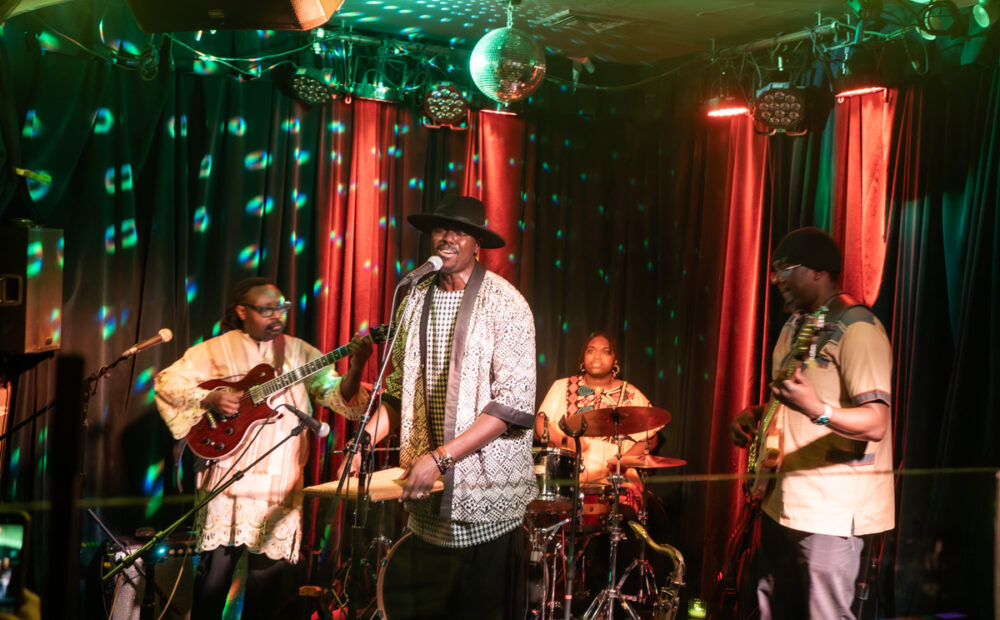
Photo by Cyril Lin Huang Nin
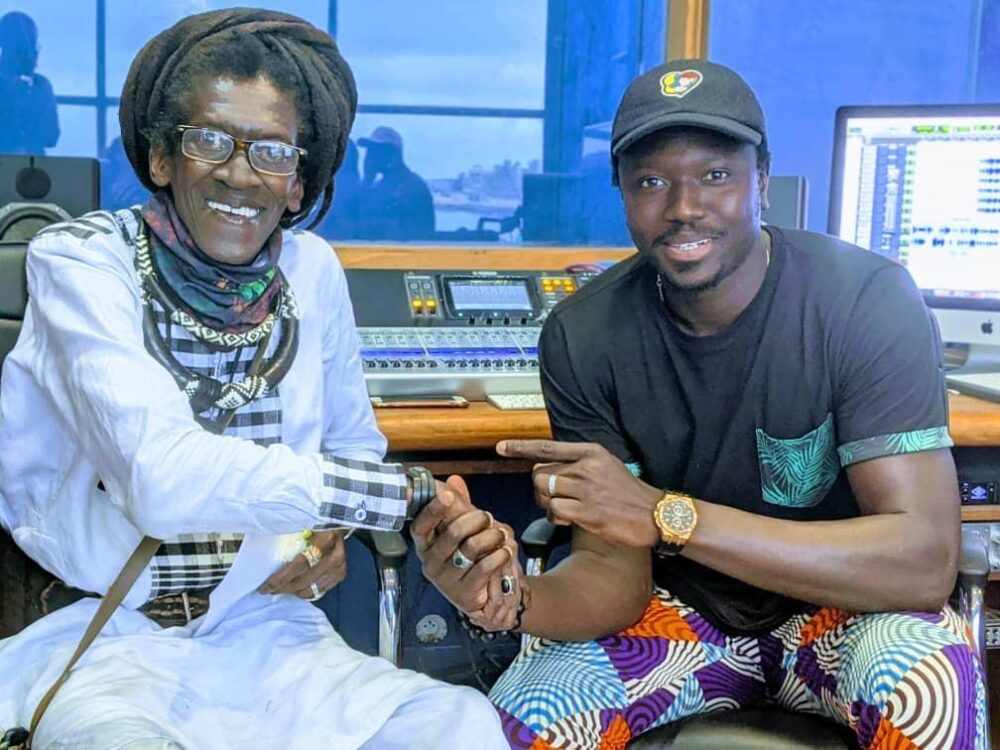
Cheikh Ibra Fam with fellow Baye Fall musician Cheikh Lo (left)
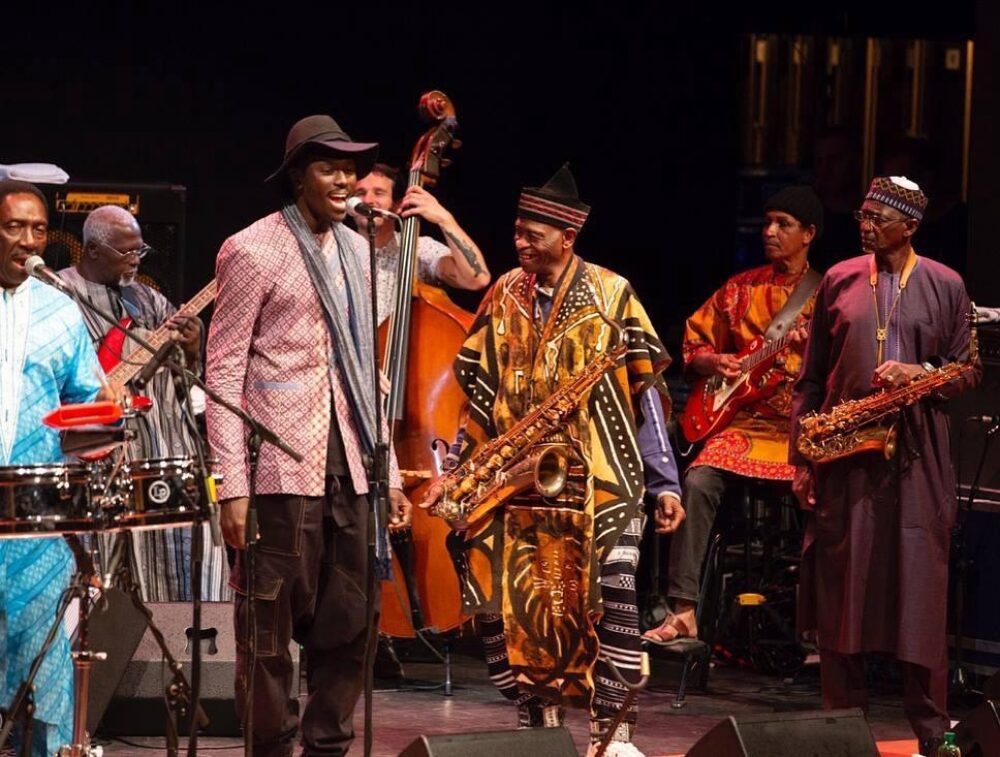
With Orchestra Baobab
Cheikh with U.S. band at Berlin, NYC, 2026. Note his kayamba shaker!

Related Audio Programs
November 14, 2019
Mbalax Meets Mande in Dakar
Mbalax music from Dakar and Mande music from Cassamance on a program about new sounds from Senegal.
December 5, 2024
The Mighty Orchestra Baobab
Pan African Orchestra Baobab, West Africa to the Afro-Cuban style of the time, the Orchestra Baobab is returning to to be a top African band.
Related Articles
Feature January 31, 2026