Feature October 20, 2023
Etienne Sevet: The Many Adventures of The Bongo Hop
<p>by Ron Deutsch</p>
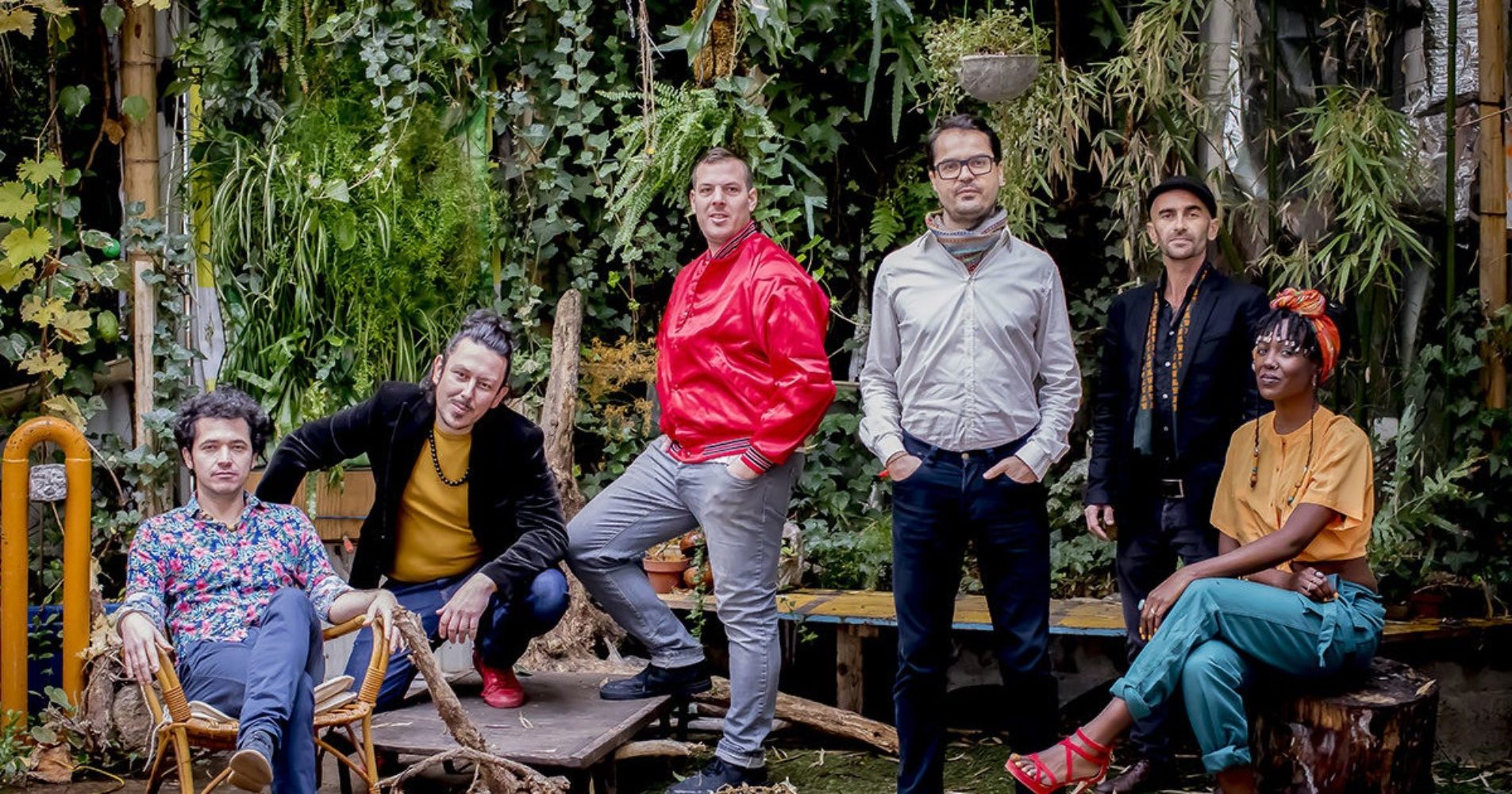
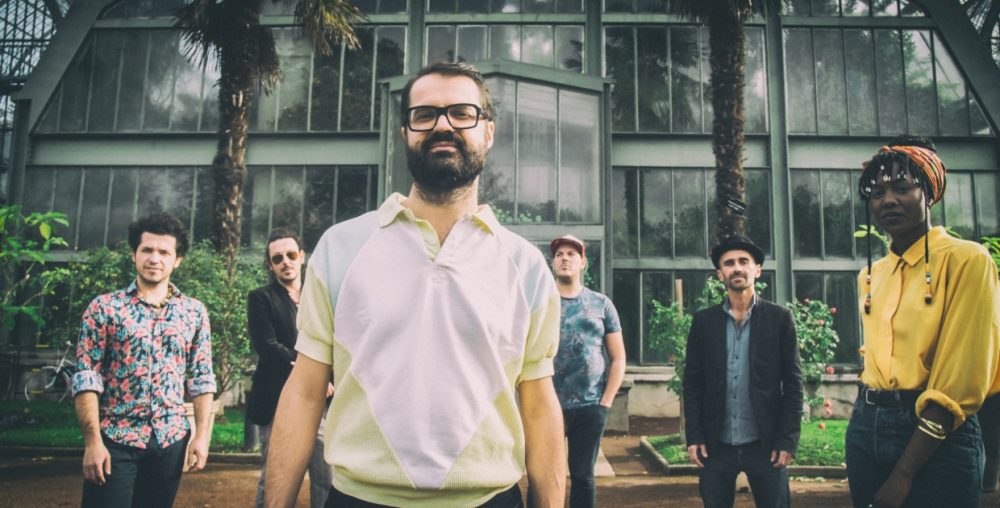
<p><strong>One of this year's headliners at the International Festival de Nuits Afrique in Montreal this summer was The Bongo Hop. </strong>This musical project came from the dreams of French journalist turned musician <em>Etienne Sevet</em>, who brought together all the favorite sounds he discovered during his adventures as a music journalist. From Colombia to Cape Verde, The Bongo Hop integrates beats, styles, and voices into familiar and surprisingly new music. For fans of Afropop Worldwide, imagine pouring all the music we feature on our program into a blender and turning it into a tasty aural shake for your ears. You hear something that sounds like cumbia, but then highlife, but now there's an afrobeat.</p>
 <p>While Sevet creates most of the music, the song's lyrics and voices
represent the same spectrum. His most prominent partner is the
Grammy-nominated Colombian singer Nidia Gongora. Gongora is known for
her Colombian folkloric ensemble Canalón de Timbiquí and her many
collaborations with British musician/producer/DJ Will Holland (aka
Quantic). But as you spin through The Bongo Hop's three albums to date,
you'll also hear the voices of Haitian Kephny Eliacin,
French-Camaroonian Cindy Pooch, Algerian Saharan Souad Asla, and others.</p>
<p>While Sevet grew up in Bordeaux in a family he credits for being
music lovers, as a young man, he focused his attention on getting a
degree in political science. His road to becoming a musician took him on
many adventures, which began in his 20s when he tried learning to play
the trumpet.</p>
<p>"I tried to play it and realized it was hard, so I didn't pursue it,"
he says. "I didn't have a super big head, but I was focused and used to
feeling like if I wanted something done, I'd get it done. And the
trumpet was the exact opposite. It was something I had to lay down
everything, start from zero, and learn to breathe. And I was like, why
must I learn how to breathe? I know how to breathe! So I totally
misunderstood the process of the trumpet then."</p>
<p>Sometime in 2003 or 2004, A good friend of Sevet's, Benoit de
Vilmorin, who was then a program director at Radio Nova, the famous
Paris radio station, had gone on a trip to Venezuela and discovered the
music of Nuyorican salsa singer Hector Levoe. Sevet also fell in love
with Lavoe's music, and he and de Vilmorin decided to go on an adventure
together.</p>
<p>"We started to think about this trip where we will go to the places
where he used to live in Puerto Rico, etc., where he grew up," Sevet
explains. "And Benoit said, 'Yeah, we can take a microphone, and we'll
just, you know, go to places and record the sounds.' And I was like,
Yeah, great. Let's do that."</p>
<p>So, the duo began planning their trip and researching Lavoe. Since
this was in the early days of the internet, they soon discovered very
little information about the singer. They thought someone must have made
a documentary film on Lavoe. Still, having found none, "We said, well,
maybe we could try and do a documentary ourselves. So that's how the
idea was born, out of nothing, in the sense that I hadn't ever filmed
anything, and neither had he. And so we started from scratch, you know,
from nothing – learning and buying cameras, learning how to film, edit,
etc."</p>
<p>"We knew we wanted to film in Puerto Rico, and we would have to meet
in New York, obviously in the Bronx and New York," Sevet continues, "but
then we had a choice to film in South America to show the South
American icon perspective of Lavoe."</p>
<p>They debated whether Venezuela or Colombia would be the better
choice, with Sevet convinced Venezuela would be as it was a center for
recording salsa music. Still, eventually, he was swayed to de Vilmoran's
pitch to go to Colombia.</p>
<p>"And guess what?" Sevet laughs. "I ended up living there eight years of my life."</p>
<figure><iframe loading="lazy" width="500" height="281" src="//www.youtube.com/embed/awSUv1CqUr0" frameborder="0" allowfullscreen=""></iframe></figure>
<p><br><br>"<em>La Voz</em>" Documentary Trailer – by Benoit de Vilmoran & Etienne Sevet</p>
<p>So, as part of their research, Sevet, who had the time and was
semi-fluent in Spanish, then headed to Colombia to scout locations and
people to interview for their documentary. </p>
<p>"So at the end of one day, a long day," he describes, "I was
interviewing people, you know, I did my job, and I started to talk to
this girl that was giving salsa classes at the hostel I was staying at,
and she said 'I'm going to a currulao concert do you want to come?' And
I'm like, 'What is curricular?' I knew there was a folkloric tradition
of music in Colombia. But I knew very little and absolutely nothing
about the Pacific coast. So I went and saw Nidia [Gongora] and Grupo
Socavon [a forerunner of Canalón de Timbiquí], but I wasn't prepared for
it. I was in shock. I wasn't prepared for this music – the patterns,
the colors –the sound colors, the voices, the harmonies of the voices. I
wasn't prepared for any of that. And that's the moment I decided to
move from Paris to Cali."</p>
<figure><iframe loading="lazy" width="500" height="281" src="//www.youtube.com/embed/t5-09Ib7_nc" frameborder="0" allowfullscreen=""></iframe></figure>
<p><em><br></em><em><br>Canalón de Timbiquí</em> - Live</p>
<p>Once settled in Cali, and after finishing the documentary, Sevet
worked as a teacher at Alliance Française for about five years, doing
freelance writing and DJ'ing at parties. However, a new adventure was
about to begin when he connected with the now-defunct World Sound
magazine. "They called me from Paris, and my assignment was to be their
correspondent for South America. So I visited Buenos Aires, Panama, Sao
Paolo Rio, Bogata, etc. Lima, too."</p>
<p>During this time, on assignment, Sevet also got to know Will Holland, who was also living in Cali, recording and producing.</p>
<figure><iframe loading="lazy" width="500" height="281" src="//www.youtube.com/embed/K5_Fusasy2s" frameborder="0" allowfullscreen=""></iframe></figure>
<p><br><br>Quantic and his Combo Barbaro (feat. Nidia Gongora) – <em>Un Canto a Mi Tierra</em></p>
<p>"I was doing interviews and writing articles about him because the
guys back in Paris were telling me I have to write about this guy," he
recalls. "So I was used to listening to Will's music as a friend and
journalist. We were in his studio one day, and he said, 'Here's my next
album. Do you want to listen to it?' I said, yeah, sure. At some point, I
may have commented that I liked this or maybe expressed some ideas, and
he said, "You should do your music, man."</p>
<p>In retrospect, Sevet says he's unsure if Holland meant that as an
encouragement or that his ideas weren't welcome. But at the time, he
took it as a call to adventure.</p>
<p>"I took it as he told me I had some good ideas and do my own music,"
he says. "And as I told you, I grew up with music but never played
myself. But this was like some kick in the ass that happened when I
passed my 30s, and I thought if I didn't start to learn an instrument
and do something with music, I would regret it. I felt I must do
something.</p>
<p>"I was then visiting at my mother's home in Bordeaux, and she told me
that the basement was a mess and I needed to get rid of all my stuff
down there. 'You don't return to Colombia before you get rid of this
shit in the basement!' So I went to the basement and started going
through all the stuff, and there was the trumpet. I decided to bring it
back with me to Colombia. It sounds so stupid because at this point in
your life if you want to learn an instrument and do something, it's
usually the guitar, piano, or bass. You should never be able to start
the trumpet at 34. Forget about it, you know? I should have chosen
another instrument, but I really liked the trumpet. It felt like a
certain obligation. It was like someone was holding a gun to my head and
was saying, 'I'll come back tomorrow, and if you haven't played, I'll
shoot you.' So, every day, I wondered how this killer would come the
next day and shoot me if I didn't practice my trumpet. So, every day,
every day. I started from absolute zero.</p>
<p>"The trumpet still has the obligation for me to play it daily," he
adds. "So you keep in touch with it. So finally, it kind of saved me,
somehow, you know? And I knew I had chosen the right instrument."</p>
<p>Upon returning to Cali, his laptop was stolen, and Holland lent him
one with some programs. He started messing around, sampling and creating
beats. And before you can say "bongo hop," he started playing along
with his trumpet and realized he had just written a song. He soon moved
back to France, to Lyon, and eventually hooked up with French
multi-instrumentalist and producer Bruno Hovart (aka Patchworks), who
began to help Sevet realize his vision of a band that defies genres. He
also took some trips to absorb music in Tanzania and Cape Verde for
World Sound.</p>
<p>But before we get to The Bongo Hop, we need to take a quick detour to
mention yet another of Sevet's adventures. While still living in Cali, a
local producer spoke to Holland about producing a record for guitar
legend, the godfather of champeta, Abelardo Carbono. </p>
<p>"And so I was there to document those sessions," Sevet recalls.
"Lucas Silva was also there. He's a producer and also is making
documentaries on Colombian music. We had met in Paris, and he's the one
who got me hooked on Abelardo a long time ago. He always wanted to
promote Abelardo's music as a pioneer of the champeta and his
psychedelic tropical sound."</p>
<p>Sevet was then prepared to shoot another documentary about Carbono,
but the recording project never happened. Holland suggested then to the
two that they should do a compilation album of Carbono's music. </p>
<p>"So I went looking for record labels to do that and found Vampisoul
in Spain," he says. "Lucas did all the clearance of all the rights, and I
wrote the liner notes inside. And it was a great success. And it
finally allowed Abelardo to have a light on himself. The media in
Colombia started to write articles about him, calling him 'the hidden
gem of the Colombian Caribbean coast.' The compilation came out in 2013.</p>
<figure><iframe loading="lazy" width="500" height="281" src="//www.youtube.com/embed/8cY2FX0MIWk" frameborder="0" allowfullscreen=""></iframe></figure>
<p><br><br>Abelardo Carbonó - <em>El maravilloso mundo de</em>...</p>
<p><strong>Now, back to the birth of The Bongo Hop...</strong></p>
<p>We had an opportunity to talk briefly with Sevet before his show at
Nuits d'Afrique Festival. Then we followed it up with a more extended
telephone conversation. We asked how he came to give his band its name
of the significance of the octopus on the cover of their latest album,
La Ñapa, and whether that had some connection to the character. The
answers to those questions relate to why we've been talking about Sevet
in terms of "his adventures."</p>
<p>"When I was a kid, my dad gave me a comic book on Christmas, which I
fell instantly in love with and read. And then I read more episodes of
this comic book because there were several episodes with the adventures
of this hero, an African seaman whose nationality still needs to be
discovered. It was a super realistic comic book, but also a lot of humor
and music. Many things were revealed to me through this comic book. In
this story, they are always smoking weed watching football, but then
there's no weed. So he goes looking for weed in Sudan but gets kidnapped
and ends up in a communist guerrilla camp. Yeah, yeah. I was a
10-year-old reading comic books about a guy smoking weed. And shagging
also. Anyway, it was funny. </p>
<p>"Well, one of the first adventures I read, is called Sur La Piste de
Bongo, which means in French 'on the bongo path.' So, a path that you
follow somewhere to go somewhere. The 'bongo' here means the weed, and
so because there's no more 'bongo,' he goes looking, gets lost, and has
these adventures. It's not that I'm a passionate weed smoker; I don't
really care about that. But I liked the idea that you have an objective,
a somehow accidental objective. Somehow you go looking for it, but you
somehow get lost, and you never get to actually do what you were
supposed to, and you do something else. And this something else is
interesting, making you grow and discover more about the world and
yourself. And the octopus is a character in the story. So I decided to
call the band The Bongo Hop because we hop from one place to the other."</p>
<p>The first album, Satingarona, Part One, was released in 2016. The
album contains several collaborations with Nidia Gongora, a couple of
tracks with vocals from Colombian rapper MaikCel, MC of the Zalama Crew,
and an appearance by Paris-based Colombian singer Pao Barreto. The
album refuses to stick to any genre. Still, the Afro-Colombian vibe is
ever-present and as danceable as an album. </p>
<p>The word "santigarona," like Sevet's compositions, is a joining
together of geographically separate places, but also connected in a way.
"It is the mixing name of two rivers dear to me," he says. "The
Satinga, which runs from the Cordillera [the chain of South American
mountain ranges] to the Pacific in Southwest Colombia, and the Garonne,
which runs from the Pyrenees to the Atlantic in Southwest France."</p>
<figure><iframe loading="lazy" width="500" height="281" src="//www.youtube.com/embed/-xEQQri4ZpE" frameborder="0" allowfullscreen=""></iframe></figure>
<p><br><br>The Bongo Hop (ft. Nidia Gongora) - "<em>Ventana</em>"</p>
<p>Satingarona, Part Two dropped in 2019 with more contributions from
Nidia, but this time also with tracks featuring Haitian singer Kephny
Eliacin and French-Camaroonian chanteuse Cindy Pooch, among others. We
asked Sevet to tell us the story behind the song "La Carga," which
offers insight into his collaborative process.</p>
<p>"I would say the lyrics derived from the music," he explains, "and it
kind of like go together. I wanted to do a song with a blues, bits of a
desert rock pattern rhythmically. At that time, I saw Mdou Moctar in
concert. I was into this music, and I wasn't afraid of doing a track
with this kind of vibe but, simultaneously, have Nidia on it. I was
fearless in mixing the two. I knew it would work despite a considerable
distance between Nigeria and Colombia. </p>
<p>"But yeah, so musically, that's how I composed the song, to give it
this vibe. It was a process because, at first, it was a song that took
another direction, another type of vibe. Still, I just realized that I
wanted to give it this direction. Anyways. I recorded the instrumental
track and then sent it to Nidia. And she said to me, 'I like it. I want
to work on it. But what do we want the lyrics to talk about?' And I
said, well, it's a music with a strong desert rock vibe. She had
absolutely no idea what this was. So I described the kind of music to
her, and I sent her some videos of Moctar and other people. So yeah, I
want the lyrics to be in line with this vibe. And she said, 'Okay,' but
that wasn't enough for her. She needed something more to start writing.
And so I gave her this anecdote...</p>
<p>"I interviewed this guy for World Sound – who did the Mdou Moctar
production – from Sahel Sounds, Chris Kirkley. And I said to him, 'Look,
man, can you give me something crazy you experienced in your travels
through the Sahara?' He said there were many crazy things he
experienced. Still, the most peculiar of all those experiences happened
one night when he was staying at a Taureg village in the desert. In the
middle of the night, they heard a big boom. They came out of their tents
and saw a huge ball of fire, wondering what it was. And then, the next
day, when they went to the place, they saw the remnants of a Boeing 737
and some tracks in the sand, so you could see somebody had visited the
Boeing during the night. 'We were wondering what was this Boeing 737
doing in the middle of the fucking desert, you know? And who came there
in the middle of the night? It was strange.'</p>
<p>"And then years later, after this interview, I remembered this
situation in Mali where the Islamist guerrillas tried to invade, and the
French government intervened to stop them on their way to the capital.
It was like 2012 or something. So when this thing happened, a lot of
journalists started covering the area and writing articles about the
situation inside and why it was so fucked up politically and in terms of
security, etc, etc. And in one outstanding article in Le Figaro – in
the middle of the article – the guy talks about, you know, drug traffic
and that people were slowly discovering that the new cocaine route is
the desert. And the guy writes about this Boeing 737 from Venezuela,
which ended up burned…. it was the same story that Chris told me. So I
was like, shit, no. </p>
<p>"So the story I'm telling you now, I basically told it to Nidia. I
said I think we have a story here that you can do a parallel between the
situation of the Taureg in the desert war who are hostages of this
violence and drug trafficking and the situation of you people in the
Colombian mangrove of the Pacific coast. And she said, 'Yeah, fuck yeah,
I can do something.' And then we had the song."</p>
<figure><iframe loading="lazy" width="500" height="281" src="//www.youtube.com/embed/2jnTC_bFHSY" frameborder="0" allowfullscreen=""></iframe></figure>
<p><br></p>
<p><br>The Bongo Hop (ft. Nidia Gongora) - "La Carga"</p>
<p>The latest album, released earlier this year, is La Ñapa, a Colombian
slang word identical to the French Creole word lagniappe. The Creoles
borrowed the word from the Spaniards, who borrowed it from the
indigenous people of South America. And they all mean something added,
something extra – like the 13th donut in a bag of a dozen.</p>
<p>"So this new record I thought of like the la ñapa of the first two
albums," Sevet explains. "Because the first two albums had a vibe, and I
had some extra songs I wanted to record in the same vibe. Plus, I
wanted to have some remixes of the songs from the first two. I also
wanted to have a Portuguese-speaking and Arab influence in the music.
Things I don't know where to put them normally in my music. I wanted to
do that and keep the same vibe, the Cali vibe – like in the title track
"La Ñapa" or "Esta Vida." But with "Maydoum Hal" – like a "desert dub"
vibe – it really differs from the rest because of that vibe. It's like a
little escape sung by an Algerian singer, Souad Asia. So for me, it was
like finishing off the first two albums, the little bonus tracks of
this two-part adventure." </p>
<figure><iframe loading="lazy" width="500" height="281" src="//www.youtube.com/embed/Kb2cwC1LMgQ" frameborder="0" allowfullscreen=""></iframe></figure>
<p><br></p>
<p><br>The Bongo Hop (feat. Souad Asla) - Maydoum Hal</p>
<p>"So that was the idea of the album," Sevet continues, "and I wanted
to make a song about la ñapa. So when I sent Nidia the instrumental, I
had already laid the title down. And she asked me, 'Why do you call it
that?' And I explained to her what I just explained to you.... and la
ñapa is meaningful in Cali. </p>
<p>"At that time, Colombia, especially Cali, was going through a vast
social unrest that ended up in Colombia having its first left-wing
president ever, which happened recently. And so, the protests were
massive, very violent, many dead people. There was an enormous food
shortage because Cali was besieged, which was crazy. But this situation
of crisis in Cali revealed the generosity of people. Usually,
everybody's fighting for their own little piece of bread. But then, they
started organizing – community soup and community food. And some people
– there was a kind of untold code among people that if you had problems
with hunger, nothing in your fridge – you could put a little red ribbon
at your window. You don't have to tell the people because people will
know that you have a food problem, and they will come and put food in
front of the door. So there was a situation of people helping each
other. I said this song is an occasion to make an homage to the culture
of Cali. </p>
<p>"So then Nidia came up with something interesting in terms of
narration – because she chose to talk about this not in a descriptive
way because it would be very boring – but she understood what I wanted
to talk about and decided to tell her own story. And the story she tells
is about this guy, a storekeeper, who faces people asking him for
credit. Generally, the grocer does it. But in this song, and since it's a
crisis, he can't do that anymore. He says, there's no more credit, but I
can give you a little bit of ñapa. That's all I can do. And so that's
basically the thing. But in the narration of the song, she develops
three points of view – the point of view of the person who's asking for
the credit, the point of view of the grocery shop, and the point of view
of a narrator, who's witnessing all that's going on."</p>
<figure><iframe loading="lazy" width="500" height="281" src="//www.youtube.com/embed/-33xO3NFoCA" frameborder="0" allowfullscreen=""></iframe></figure>
<p><br></p>
<p>The Bongo Hop Ft. Nidia Gongora - "La Ñapa"</p>
<p>So, with this three-album adventure ending, we asked Sevet what's next for The Bongo Hop.</p>
<p>"My projects have been with Latino, Colombian, Afro-Colombian music,
so I think it's fun to have something a bit different," he says. "I
think the next one will be different in terms of sound that it feels
different in terms of music too."</p>
<p>While Sevet creates most of the music, the song's lyrics and voices
represent the same spectrum. His most prominent partner is the
Grammy-nominated Colombian singer Nidia Gongora. Gongora is known for
her Colombian folkloric ensemble Canalón de Timbiquí and her many
collaborations with British musician/producer/DJ Will Holland (aka
Quantic). But as you spin through The Bongo Hop's three albums to date,
you'll also hear the voices of Haitian Kephny Eliacin,
French-Camaroonian Cindy Pooch, Algerian Saharan Souad Asla, and others.</p>
<p>While Sevet grew up in Bordeaux in a family he credits for being
music lovers, as a young man, he focused his attention on getting a
degree in political science. His road to becoming a musician took him on
many adventures, which began in his 20s when he tried learning to play
the trumpet.</p>
<p>"I tried to play it and realized it was hard, so I didn't pursue it,"
he says. "I didn't have a super big head, but I was focused and used to
feeling like if I wanted something done, I'd get it done. And the
trumpet was the exact opposite. It was something I had to lay down
everything, start from zero, and learn to breathe. And I was like, why
must I learn how to breathe? I know how to breathe! So I totally
misunderstood the process of the trumpet then."</p>
<p>Sometime in 2003 or 2004, A good friend of Sevet's, Benoit de
Vilmorin, who was then a program director at Radio Nova, the famous
Paris radio station, had gone on a trip to Venezuela and discovered the
music of Nuyorican salsa singer Hector Levoe. Sevet also fell in love
with Lavoe's music, and he and de Vilmorin decided to go on an adventure
together.</p>
<p>"We started to think about this trip where we will go to the places
where he used to live in Puerto Rico, etc., where he grew up," Sevet
explains. "And Benoit said, 'Yeah, we can take a microphone, and we'll
just, you know, go to places and record the sounds.' And I was like,
Yeah, great. Let's do that."</p>
<p>So, the duo began planning their trip and researching Lavoe. Since
this was in the early days of the internet, they soon discovered very
little information about the singer. They thought someone must have made
a documentary film on Lavoe. Still, having found none, "We said, well,
maybe we could try and do a documentary ourselves. So that's how the
idea was born, out of nothing, in the sense that I hadn't ever filmed
anything, and neither had he. And so we started from scratch, you know,
from nothing – learning and buying cameras, learning how to film, edit,
etc."</p>
<p>"We knew we wanted to film in Puerto Rico, and we would have to meet
in New York, obviously in the Bronx and New York," Sevet continues, "but
then we had a choice to film in South America to show the South
American icon perspective of Lavoe."</p>
<p>They debated whether Venezuela or Colombia would be the better
choice, with Sevet convinced Venezuela would be as it was a center for
recording salsa music. Still, eventually, he was swayed to de Vilmoran's
pitch to go to Colombia.</p>
<p>"And guess what?" Sevet laughs. "I ended up living there eight years of my life."</p>
<figure><iframe loading="lazy" width="500" height="281" src="//www.youtube.com/embed/awSUv1CqUr0" frameborder="0" allowfullscreen=""></iframe></figure>
<p><br><br>"<em>La Voz</em>" Documentary Trailer – by Benoit de Vilmoran & Etienne Sevet</p>
<p>So, as part of their research, Sevet, who had the time and was
semi-fluent in Spanish, then headed to Colombia to scout locations and
people to interview for their documentary. </p>
<p>"So at the end of one day, a long day," he describes, "I was
interviewing people, you know, I did my job, and I started to talk to
this girl that was giving salsa classes at the hostel I was staying at,
and she said 'I'm going to a currulao concert do you want to come?' And
I'm like, 'What is curricular?' I knew there was a folkloric tradition
of music in Colombia. But I knew very little and absolutely nothing
about the Pacific coast. So I went and saw Nidia [Gongora] and Grupo
Socavon [a forerunner of Canalón de Timbiquí], but I wasn't prepared for
it. I was in shock. I wasn't prepared for this music – the patterns,
the colors –the sound colors, the voices, the harmonies of the voices. I
wasn't prepared for any of that. And that's the moment I decided to
move from Paris to Cali."</p>
<figure><iframe loading="lazy" width="500" height="281" src="//www.youtube.com/embed/t5-09Ib7_nc" frameborder="0" allowfullscreen=""></iframe></figure>
<p><em><br></em><em><br>Canalón de Timbiquí</em> - Live</p>
<p>Once settled in Cali, and after finishing the documentary, Sevet
worked as a teacher at Alliance Française for about five years, doing
freelance writing and DJ'ing at parties. However, a new adventure was
about to begin when he connected with the now-defunct World Sound
magazine. "They called me from Paris, and my assignment was to be their
correspondent for South America. So I visited Buenos Aires, Panama, Sao
Paolo Rio, Bogata, etc. Lima, too."</p>
<p>During this time, on assignment, Sevet also got to know Will Holland, who was also living in Cali, recording and producing.</p>
<figure><iframe loading="lazy" width="500" height="281" src="//www.youtube.com/embed/K5_Fusasy2s" frameborder="0" allowfullscreen=""></iframe></figure>
<p><br><br>Quantic and his Combo Barbaro (feat. Nidia Gongora) – <em>Un Canto a Mi Tierra</em></p>
<p>"I was doing interviews and writing articles about him because the
guys back in Paris were telling me I have to write about this guy," he
recalls. "So I was used to listening to Will's music as a friend and
journalist. We were in his studio one day, and he said, 'Here's my next
album. Do you want to listen to it?' I said, yeah, sure. At some point, I
may have commented that I liked this or maybe expressed some ideas, and
he said, "You should do your music, man."</p>
<p>In retrospect, Sevet says he's unsure if Holland meant that as an
encouragement or that his ideas weren't welcome. But at the time, he
took it as a call to adventure.</p>
<p>"I took it as he told me I had some good ideas and do my own music,"
he says. "And as I told you, I grew up with music but never played
myself. But this was like some kick in the ass that happened when I
passed my 30s, and I thought if I didn't start to learn an instrument
and do something with music, I would regret it. I felt I must do
something.</p>
<p>"I was then visiting at my mother's home in Bordeaux, and she told me
that the basement was a mess and I needed to get rid of all my stuff
down there. 'You don't return to Colombia before you get rid of this
shit in the basement!' So I went to the basement and started going
through all the stuff, and there was the trumpet. I decided to bring it
back with me to Colombia. It sounds so stupid because at this point in
your life if you want to learn an instrument and do something, it's
usually the guitar, piano, or bass. You should never be able to start
the trumpet at 34. Forget about it, you know? I should have chosen
another instrument, but I really liked the trumpet. It felt like a
certain obligation. It was like someone was holding a gun to my head and
was saying, 'I'll come back tomorrow, and if you haven't played, I'll
shoot you.' So, every day, I wondered how this killer would come the
next day and shoot me if I didn't practice my trumpet. So, every day,
every day. I started from absolute zero.</p>
<p>"The trumpet still has the obligation for me to play it daily," he
adds. "So you keep in touch with it. So finally, it kind of saved me,
somehow, you know? And I knew I had chosen the right instrument."</p>
<p>Upon returning to Cali, his laptop was stolen, and Holland lent him
one with some programs. He started messing around, sampling and creating
beats. And before you can say "bongo hop," he started playing along
with his trumpet and realized he had just written a song. He soon moved
back to France, to Lyon, and eventually hooked up with French
multi-instrumentalist and producer Bruno Hovart (aka Patchworks), who
began to help Sevet realize his vision of a band that defies genres. He
also took some trips to absorb music in Tanzania and Cape Verde for
World Sound.</p>
<p>But before we get to The Bongo Hop, we need to take a quick detour to
mention yet another of Sevet's adventures. While still living in Cali, a
local producer spoke to Holland about producing a record for guitar
legend, the godfather of champeta, Abelardo Carbono. </p>
<p>"And so I was there to document those sessions," Sevet recalls.
"Lucas Silva was also there. He's a producer and also is making
documentaries on Colombian music. We had met in Paris, and he's the one
who got me hooked on Abelardo a long time ago. He always wanted to
promote Abelardo's music as a pioneer of the champeta and his
psychedelic tropical sound."</p>
<p>Sevet was then prepared to shoot another documentary about Carbono,
but the recording project never happened. Holland suggested then to the
two that they should do a compilation album of Carbono's music. </p>
<p>"So I went looking for record labels to do that and found Vampisoul
in Spain," he says. "Lucas did all the clearance of all the rights, and I
wrote the liner notes inside. And it was a great success. And it
finally allowed Abelardo to have a light on himself. The media in
Colombia started to write articles about him, calling him 'the hidden
gem of the Colombian Caribbean coast.' The compilation came out in 2013.</p>
<figure><iframe loading="lazy" width="500" height="281" src="//www.youtube.com/embed/8cY2FX0MIWk" frameborder="0" allowfullscreen=""></iframe></figure>
<p><br><br>Abelardo Carbonó - <em>El maravilloso mundo de</em>...</p>
<p><strong>Now, back to the birth of The Bongo Hop...</strong></p>
<p>We had an opportunity to talk briefly with Sevet before his show at
Nuits d'Afrique Festival. Then we followed it up with a more extended
telephone conversation. We asked how he came to give his band its name
of the significance of the octopus on the cover of their latest album,
La Ñapa, and whether that had some connection to the character. The
answers to those questions relate to why we've been talking about Sevet
in terms of "his adventures."</p>
<p>"When I was a kid, my dad gave me a comic book on Christmas, which I
fell instantly in love with and read. And then I read more episodes of
this comic book because there were several episodes with the adventures
of this hero, an African seaman whose nationality still needs to be
discovered. It was a super realistic comic book, but also a lot of humor
and music. Many things were revealed to me through this comic book. In
this story, they are always smoking weed watching football, but then
there's no weed. So he goes looking for weed in Sudan but gets kidnapped
and ends up in a communist guerrilla camp. Yeah, yeah. I was a
10-year-old reading comic books about a guy smoking weed. And shagging
also. Anyway, it was funny. </p>
<p>"Well, one of the first adventures I read, is called Sur La Piste de
Bongo, which means in French 'on the bongo path.' So, a path that you
follow somewhere to go somewhere. The 'bongo' here means the weed, and
so because there's no more 'bongo,' he goes looking, gets lost, and has
these adventures. It's not that I'm a passionate weed smoker; I don't
really care about that. But I liked the idea that you have an objective,
a somehow accidental objective. Somehow you go looking for it, but you
somehow get lost, and you never get to actually do what you were
supposed to, and you do something else. And this something else is
interesting, making you grow and discover more about the world and
yourself. And the octopus is a character in the story. So I decided to
call the band The Bongo Hop because we hop from one place to the other."</p>
<p>The first album, Satingarona, Part One, was released in 2016. The
album contains several collaborations with Nidia Gongora, a couple of
tracks with vocals from Colombian rapper MaikCel, MC of the Zalama Crew,
and an appearance by Paris-based Colombian singer Pao Barreto. The
album refuses to stick to any genre. Still, the Afro-Colombian vibe is
ever-present and as danceable as an album. </p>
<p>The word "santigarona," like Sevet's compositions, is a joining
together of geographically separate places, but also connected in a way.
"It is the mixing name of two rivers dear to me," he says. "The
Satinga, which runs from the Cordillera [the chain of South American
mountain ranges] to the Pacific in Southwest Colombia, and the Garonne,
which runs from the Pyrenees to the Atlantic in Southwest France."</p>
<figure><iframe loading="lazy" width="500" height="281" src="//www.youtube.com/embed/-xEQQri4ZpE" frameborder="0" allowfullscreen=""></iframe></figure>
<p><br><br>The Bongo Hop (ft. Nidia Gongora) - "<em>Ventana</em>"</p>
<p>Satingarona, Part Two dropped in 2019 with more contributions from
Nidia, but this time also with tracks featuring Haitian singer Kephny
Eliacin and French-Camaroonian chanteuse Cindy Pooch, among others. We
asked Sevet to tell us the story behind the song "La Carga," which
offers insight into his collaborative process.</p>
<p>"I would say the lyrics derived from the music," he explains, "and it
kind of like go together. I wanted to do a song with a blues, bits of a
desert rock pattern rhythmically. At that time, I saw Mdou Moctar in
concert. I was into this music, and I wasn't afraid of doing a track
with this kind of vibe but, simultaneously, have Nidia on it. I was
fearless in mixing the two. I knew it would work despite a considerable
distance between Nigeria and Colombia. </p>
<p>"But yeah, so musically, that's how I composed the song, to give it
this vibe. It was a process because, at first, it was a song that took
another direction, another type of vibe. Still, I just realized that I
wanted to give it this direction. Anyways. I recorded the instrumental
track and then sent it to Nidia. And she said to me, 'I like it. I want
to work on it. But what do we want the lyrics to talk about?' And I
said, well, it's a music with a strong desert rock vibe. She had
absolutely no idea what this was. So I described the kind of music to
her, and I sent her some videos of Moctar and other people. So yeah, I
want the lyrics to be in line with this vibe. And she said, 'Okay,' but
that wasn't enough for her. She needed something more to start writing.
And so I gave her this anecdote...</p>
<p>"I interviewed this guy for World Sound – who did the Mdou Moctar
production – from Sahel Sounds, Chris Kirkley. And I said to him, 'Look,
man, can you give me something crazy you experienced in your travels
through the Sahara?' He said there were many crazy things he
experienced. Still, the most peculiar of all those experiences happened
one night when he was staying at a Taureg village in the desert. In the
middle of the night, they heard a big boom. They came out of their tents
and saw a huge ball of fire, wondering what it was. And then, the next
day, when they went to the place, they saw the remnants of a Boeing 737
and some tracks in the sand, so you could see somebody had visited the
Boeing during the night. 'We were wondering what was this Boeing 737
doing in the middle of the fucking desert, you know? And who came there
in the middle of the night? It was strange.'</p>
<p>"And then years later, after this interview, I remembered this
situation in Mali where the Islamist guerrillas tried to invade, and the
French government intervened to stop them on their way to the capital.
It was like 2012 or something. So when this thing happened, a lot of
journalists started covering the area and writing articles about the
situation inside and why it was so fucked up politically and in terms of
security, etc, etc. And in one outstanding article in Le Figaro – in
the middle of the article – the guy talks about, you know, drug traffic
and that people were slowly discovering that the new cocaine route is
the desert. And the guy writes about this Boeing 737 from Venezuela,
which ended up burned…. it was the same story that Chris told me. So I
was like, shit, no. </p>
<p>"So the story I'm telling you now, I basically told it to Nidia. I
said I think we have a story here that you can do a parallel between the
situation of the Taureg in the desert war who are hostages of this
violence and drug trafficking and the situation of you people in the
Colombian mangrove of the Pacific coast. And she said, 'Yeah, fuck yeah,
I can do something.' And then we had the song."</p>
<figure><iframe loading="lazy" width="500" height="281" src="//www.youtube.com/embed/2jnTC_bFHSY" frameborder="0" allowfullscreen=""></iframe></figure>
<p><br></p>
<p><br>The Bongo Hop (ft. Nidia Gongora) - "La Carga"</p>
<p>The latest album, released earlier this year, is La Ñapa, a Colombian
slang word identical to the French Creole word lagniappe. The Creoles
borrowed the word from the Spaniards, who borrowed it from the
indigenous people of South America. And they all mean something added,
something extra – like the 13th donut in a bag of a dozen.</p>
<p>"So this new record I thought of like the la ñapa of the first two
albums," Sevet explains. "Because the first two albums had a vibe, and I
had some extra songs I wanted to record in the same vibe. Plus, I
wanted to have some remixes of the songs from the first two. I also
wanted to have a Portuguese-speaking and Arab influence in the music.
Things I don't know where to put them normally in my music. I wanted to
do that and keep the same vibe, the Cali vibe – like in the title track
"La Ñapa" or "Esta Vida." But with "Maydoum Hal" – like a "desert dub"
vibe – it really differs from the rest because of that vibe. It's like a
little escape sung by an Algerian singer, Souad Asia. So for me, it was
like finishing off the first two albums, the little bonus tracks of
this two-part adventure." </p>
<figure><iframe loading="lazy" width="500" height="281" src="//www.youtube.com/embed/Kb2cwC1LMgQ" frameborder="0" allowfullscreen=""></iframe></figure>
<p><br></p>
<p><br>The Bongo Hop (feat. Souad Asla) - Maydoum Hal</p>
<p>"So that was the idea of the album," Sevet continues, "and I wanted
to make a song about la ñapa. So when I sent Nidia the instrumental, I
had already laid the title down. And she asked me, 'Why do you call it
that?' And I explained to her what I just explained to you.... and la
ñapa is meaningful in Cali. </p>
<p>"At that time, Colombia, especially Cali, was going through a vast
social unrest that ended up in Colombia having its first left-wing
president ever, which happened recently. And so, the protests were
massive, very violent, many dead people. There was an enormous food
shortage because Cali was besieged, which was crazy. But this situation
of crisis in Cali revealed the generosity of people. Usually,
everybody's fighting for their own little piece of bread. But then, they
started organizing – community soup and community food. And some people
– there was a kind of untold code among people that if you had problems
with hunger, nothing in your fridge – you could put a little red ribbon
at your window. You don't have to tell the people because people will
know that you have a food problem, and they will come and put food in
front of the door. So there was a situation of people helping each
other. I said this song is an occasion to make an homage to the culture
of Cali. </p>
<p>"So then Nidia came up with something interesting in terms of
narration – because she chose to talk about this not in a descriptive
way because it would be very boring – but she understood what I wanted
to talk about and decided to tell her own story. And the story she tells
is about this guy, a storekeeper, who faces people asking him for
credit. Generally, the grocer does it. But in this song, and since it's a
crisis, he can't do that anymore. He says, there's no more credit, but I
can give you a little bit of ñapa. That's all I can do. And so that's
basically the thing. But in the narration of the song, she develops
three points of view – the point of view of the person who's asking for
the credit, the point of view of the grocery shop, and the point of view
of a narrator, who's witnessing all that's going on."</p>
<figure><iframe loading="lazy" width="500" height="281" src="//www.youtube.com/embed/-33xO3NFoCA" frameborder="0" allowfullscreen=""></iframe></figure>
<p><br></p>
<p>The Bongo Hop Ft. Nidia Gongora - "La Ñapa"</p>
<p>So, with this three-album adventure ending, we asked Sevet what's next for The Bongo Hop.</p>
<p>"My projects have been with Latino, Colombian, Afro-Colombian music,
so I think it's fun to have something a bit different," he says. "I
think the next one will be different in terms of sound that it feels
different in terms of music too."</p>

Related Articles

Feature November 10, 2004